08. Edge-Matching & Fragment Reassembly¶
This chapter covers the repository's fragment-reassembly subsystem: the
EdgeMatch ribbon tab (10 components) and the Rhino-free engine it wraps,
Frahan.EdgeMatching.Core, together with the closed-form rigid-registration
kernels in Frahan.StonePack.Core/Registration. The task is fracture
reassembly: given the broken pieces of a stone object (a Trencadís mosaic, a
shattered ceramic, a quarry block split along a joint) recover the rigid
motion that brings every mating boundary back into contact without
interpenetration.
The engine is a five-stage pipeline declared verbatim on the solver component
(EdgeMatchSolveComponent.cs:23-27):
- Boundary segmenter — split each contour at curvature breaks, build a signed-turning signature per segment.
- Segment hash index — rotation/translation-invariant bucketing for complement lookup.
- Phase correlator — coarse lag between two turning signatures.
- Constrained ICP — closed-form rigid alignment, refined to convergence (Besl and McKay 1992; MathNet SVD Kabsch).
- Assembly solver — beam-search (frame-anchored) or agglomerative minimum-residual spanning tree (R0).
Three opt-in research increments ride on top of the five stages: A1 (scale-
relative gates), R1 (partial sub-segment matching), R2 (global non-overlap
resolve), the Soft-ICP refiner (Coherent Point Drift soft correspondence plus a
non-penetration hinge), and the projection bootstrap that unblocks the
geometric 3D path. Every increment defaults OFF, so the shipped default path is
byte-for-byte the original beam (AssemblyOptions.cs:28, :44, :93, :135,
:197, :229).
The mathematics here is rigid-motion estimation on \(SE(2)\) and \(SE(3)\): the
turning-angle edge descriptor, the orthogonal-Procrustes / Kabsch rigid fit and
its mandatory reflection guard, a monotone non-crossing correspondence DP, and a
soft-assignment EM alternation. Where the repository evolved the published math
we show the derivation. Every originality claim is anchored to a file:line, an
[Algorithm] attribute, or a measured benchmark.
1. The edge descriptor: signed-turning signature¶
1.1 Definition¶
A fracture rim is a planar (or per-facet planar) open curve. The descriptor is the signed turning angle sampled at even arc length. For three consecutive resampled points \(p_{i-1},p_i,p_{i+1}\) in the panel-local XY plane, with edge vectors \(u=p_i-p_{i-1}\) and \(v=p_{i+1}-p_i\), the turning at \(p_i\) is
The cross product \(u_xv_y-u_yv_x\) carries the sign (left turn positive, right
turn negative); the dot product disambiguates the quadrant. This is exactly
BoundarySegmenter.SignedTurn (BoundarySegmenter.cs:151-158). The signature
of a segment is the turning sequence resampled to a fixed bin count
SignatureBins by piecewise-linear interpolation
(BoundarySegmenter.cs:74, :171-189), so two rims of different vertex counts
are comparable.
1.2 Why signed turning is the canonical 2D signal¶
Turning angle is invariant under rigid motion: rotating or translating the curve leaves every \(\tau_i\) unchanged, because \(\tau_i\) is built only from relative edge directions. It is the discrete analogue of the curve's signed curvature integrated over arc length,
so the per-segment total \(\sum_i\tau_i\) is the segment's net turning
(TotalTurning, BoundarySegmenter.cs:70-72), a rotation-invariant scalar used
directly as a hash bin. The sign of the total fixes the segment's convex/concave
character (Sign, :72), which is the key fact for matching: two mating
fracture rims traverse the same physical curve in opposite senses, so their
turning signatures are reverse-and-negate images of each other.
1.3 Break-point detection¶
Segment boundaries are placed where the windowed turning sum exceeds a threshold
\(\theta=\texttt{BreakAngleDeg}\) (BoundarySegmenter.cs:37-45):
with window half-width \(w=\texttt{BreakWindow}\). Nearby breaks are coalesced
(:160-169) so a single sharp corner yields one break, not a cluster. The 3D
sibling BoundarySegmenter3D adds a torsion signature (the out-of-plane
signal), null for planar panels, used only for 3D mirror disambiguation
(Segment.cs:25, :9-13).
Originality. The signed-turning descriptor and the break-point segmenter are
clean-room, built from the standard turning-function representation of plane
curves (Arkin et al. 1991). The [Algorithm("Boundary segmenter",
"Frahan-original arc-length curvature/torsion signature")] attribute
(EdgeMatchSolveComponent.cs:23) claims the implementation, not the turning
function itself. Tier B/C (faithful reimplementation of a textbook
representation).
2. The segment hash index¶
To avoid an all-pairs comparison the segments are bucketed by a
rotation/translation-invariant key (SegmentHashKey.cs). The 2D key is the
five-tuple
with \(L\) the chord length, \(T\) the total turning, and \(\mu,\sigma\) the mean and
standard deviation of the turning signature, each quantised by its bin size
(SegmentHashIndex.cs:KeyOf). Every term is rigid-invariant, so two segments
fall in the same bucket only if they are plausibly the same shape up to pose. A
complement query looks up the bucket of the reverse-and-negate image of a
segment, returning candidate mating edges in \(O(1)\) expected time
(SegmentHashIndex.cs:97, QueryComplement). The 3D key extends the tuple with
planarity and torsion-variance bins (SegmentHashKey3D), and 2D and 3D segments
never cross-match by construction (SegmentHashIndex.cs:12-15).
Originality. clean-room / Frahan-original invariant hashing
([Algorithm("Segment hash index", "Frahan-original planarity-aware spatial
bucketing")], EdgeMatchSolveComponent.cs:24). Tier C: a standard
locality-style index, but the planarity-aware 2D/3D split is the local
increment. A known limitation is recorded in section 8: independently tessellated
3D rims hash to disjoint buckets (cross-panel hits = 0), which is precisely why
the projection bootstrap exists.
3. Phase correlation: the coarse lag¶
Before any ICP the matcher finds the best cyclic alignment of two equal-length
turning signatures \(a,b\). Because mating rims are reverse-and-negate images, the
second signature is first flipped, \(b^{\flat}_i=-b_{n-1-i}\)
(PhaseCorrelator.cs:23-24), then the lag minimising the \(L_1\) disagreement is
chosen:
The score is normalised to a similarity in \([0,1]\) using the fact that
per-sample turning is bounded by \(\pi\), so the worst-case disagreement is
\(2\pi n\) (PhaseCorrelator.cs:39-43):
A pair is admitted only if \(\mathrm{sim}\ge\texttt{PhaseScoreThreshold}\)
(default \(0.5\), AssemblyOptions.cs:65). This is the cheap gate that keeps the
expensive ICP off non-complementary pairs.
Originality. clean-room classical cross-correlation lag estimation
([Algorithm("Phase correlator FFT", "Classical cross-correlation lag
estimation")], EdgeMatchSolveComponent.cs:25). The attribute name says "FFT";
the shipped code is a direct \(O(n^2)\) circular \(L_1\) correlation, not an FFT,
which is correct and deterministic at these signature lengths (a documentation
nit, flagged in section 9). Tier C.
4. Constrained ICP and the rigid-fit derivation¶
Stage 4 is the geometric heart: iterative closest point with a closed-form
rigid update per iteration, plus a penetration guard. Two implementations exist,
ConstrainedIcp2D and ConstrainedIcp3D, sharing the same outer loop
(Besl and McKay 1992).
4.1 The ICP outer loop¶
Given source segment \(A\) (sampled to points \(\{a_i\}\)) and target \(B\) (a
polyline curve), each iteration (ConstrainedIcp3D.cs:60-142):
- Push \(A\) through the current pose \(g_k\in SE(d)\): \(a_i^{(k)}=g_k\,a_i\).
- Correspondence: for each \(a_i^{(k)}\) find the closest point \(b_i\) on \(B\)
(
bCurve.ClosestPoint,:109-110), or, when the order-preserving mode is on, a monotone non-crossing pairing (section 5). - Alignment: solve the closed-form rigid fit
\(\delta=\arg\min_{g}\sum_i\|g\,a_i^{(k)}-b_i\|^2\) and update
\(g_{k+1}=\delta\,g_k\) (
:116-118). - Guard: reject the step if it would push \(A\)'s centroid inside \(B\)'s
panel interior, or onto the wrong side of a substrate; penalise the residual
instead of accepting (
:119-128).
The residual is the mean correspondence distance; convergence is declared when
the per-step translation and rotation both fall below tolerance, or the residual
stalls (:131-140). The monotone convergence of this alternation to a local
minimum is the standard ICP result (Besl and McKay 1992): the correspondence
step can only lower (or hold) the residual, and the optimal-fit step minimises it
exactly, so the residual is non-increasing.
4.2 The 3D rigid fit (Kabsch / orthogonal Procrustes via SVD)¶
The inner solve is the orthogonal-Procrustes problem. We want \(R\in SO(3)\) and \(t\in\mathbb{R}^3\) minimising
Derivation. Centre both sets: let \(\bar a=\tfrac1n\sum_i a_i\), \(\bar b=\tfrac1n\sum_i b_i\), and \(a_i'=a_i-\bar a\), \(b_i'=b_i-\bar b\). For fixed \(R\) the optimal translation is found by \(\partial E/\partial t=0\), giving \(t=\bar b-R\bar a\), which cancels the centroids and leaves
Minimising \(E(R)\) is therefore maximising \(\operatorname{tr}(RH)\) over rotations. Take the SVD \(H=U\Sigma V^\top\). Then \(\operatorname{tr}(RH)=\operatorname{tr}(R U\Sigma V^\top)=\operatorname{tr}(\Sigma\,V^\top R U)\), and since \(V^\top R U\) is orthogonal its diagonal entries are \(\le 1\), so the trace is maximised when \(V^\top R U=I\), i.e.
This is the cross-covariance \(H\) assembled at ConstrainedIcp3D.cs:158-166, the
SVD at :168, and \(R=VDU^\top\) at :179.
The reflection guard. \(VU^\top\) can have determinant \(-1\) (a reflection, the unconstrained orthogonal-Procrustes minimiser) when the points are coplanar or noisy. To force \(R\in SO(3)\) we insert a sign-fixing diagonal \(D=\operatorname{diag}(1,1,d)\) with
which flips the smallest-singular-value axis only, the provably minimal change
that restores a proper rotation (Umeyama 1991). The repository's implementation
makes a hard correctness point at ConstrainedIcp3D.cs:172-177: the sign is
computed with Matrix.Determinant(), not Math.Sign, because
Math.Sign returns \(0\) on a degenerate determinant and would silently skip the
flip, returning a mirror-image alignment in place of a rotation. The code comment
flags this as spec item D8; the same guard is duplicated in the Soft-ICP M-step
(SoftIcpRefiner.cs:439-442). The translation is then recovered as
\(t=\bar b-R\bar a\) (:185-187).
4.3 The 2D rigid fit reduces to a single atan2¶
In the plane the rotation has one degree of freedom, so the SVD collapses. With the centred cross-covariance entries \(S_{xx}=\sum a_x'b_x'\), \(S_{xy}=\sum a_x'b_y'\), \(S_{yx}=\sum a_y'b_x'\), \(S_{yy}=\sum a_y'b_y'\), maximising \(\operatorname{tr}(R(\theta)H)\) over the planar rotation \(R(\theta)\) gives, after \(\partial/\partial\theta=0\),
exactly ConstrainedIcp2D.SvdRigid2D (ConstrainedIcp2D.cs:163-193). This is
the planar Kabsch in closed form with no matrix factorisation, the same answer
the SVD would give but cheaper and branch-free.
4.4 The penetration guard¶
The matcher rewards edge contact but must not let a piece's body pass through its
neighbour. After each trial pose the 3D guard projects \(A\)'s centroid onto \(B\)'s
local frame and tests containment in \(B\)'s flattened contour
(ConstrainedIcp3D.cs:191-213); if inside, the step is rejected and the residual
is multiplied by PenetrationPenalty so the beam de-ranks it
(:127). An optional substrate test rejects any sample on the wrong side of a
backing surface normal (:215-237). The 2D guard is the same idea on the closed
contour (ConstrainedIcp2D.cs:114-117).
Originality. The ICP loop and SVD/atan2 rigid fit are clean-room
implementations of published math ([Algorithm("Constrained ICP", "Besl and
McKay 1992 iterative closest point; MathNet.Numerics SVD")],
EdgeMatchSolveComponent.cs:26; the SVD itself is the vendored
MathNet.Numerics package). The constrained adjective is the local increment:
the centroid-penetration and substrate-side guards have no equivalent in vanilla
ICP and turn a registration routine into a non-overlapping assembler. Tier B with
a B-level engineering delta.
5. Order-preserving correspondence: a monotone non-crossing DP¶
Free nearest-neighbour ICP can produce tangled correspondences on wiggly rims:
\(a_i\) matches \(b_j\) while \(a_{i+1}\) matches \(b_{j-3}\), so the matched chords
cross and the fit is biased. The opt-in non-crossing mode
(AssemblyOptions.cs:44) replaces nearest-neighbour with a monotone dynamic
program (OrderedBoundaryMatcher.cs).
The correspondence must be monotone: if \((i,j)\) and \((i',j')\) are both matched with \(i<i'\) then \(j\le j'\). This is enforced by a Dynamic-Time-Warping style DP over the \(n\times m\) squared-distance grid \(C_{ij}=\|a_i-b_j\|^2\) with three monotone moves into cell \((i,j)\):
diagonal (advance both, emit a pair), up (advance \(A\), gap in \(B\)), left
(advance \(B\), gap in \(A\)), with the diagonal preferred on ties so the path hugs
the main correspondence and stays deterministic
(OrderedBoundaryMatcher.cs:100-131). Backtracking from \((n-1,m-1)\) emits a pair
only on diagonal moves, which makes the emitted correspondence both non-crossing
and one-to-one (:145-167). An optional index band maxGap bounds how far the
two running indices may diverge, with a graceful fall back to the unbounded DP if
the band is too tight (:133-138).
Closed rims have no canonical start and may run in either sense, so
MatchClosed brackets a set of cyclic offsets (seeded by the phase-correlation
lag) and tries both the forward and reversed orientation, keeping the candidate
with the lowest mean matched distance (:188-241).
Originality. clean-room with an explicit, honest provenance note. The
file header (OrderedBoundaryMatcher.cs:24-37) cites the minimum-weight
non-crossing matching idea of Marcotte and Suri (1991) and the user's own
reference implementation, then states plainly that a verbatim port does not
apply: Marcotte-Suri matches points among themselves on a single convex polygon
in \(O(N\log N)\), whereas this problem matches points between two arbitrary
non-convex rims, for which the monotone DP is the correct general primitive. The
DTW lineage is the engineering substrate. Tier C, with the non-crossing-on-two-
sequences framing as the local increment.
6. The initial transform¶
ICP needs a basin-of-attraction seed. InitialTransformBuilder.FromLag2D
(InitialTransformBuilder.cs:16-40) anchors a plane at \(A\)'s start point with
its first edge as the x-axis, and a plane at \(B\)'s lag-shifted sample with the
negated local tangent as its x-axis, then returns the plane-to-plane map.
The negation enforces the complement orientation: matching edges traverse the
fracture in opposite senses, so \(B\)'s frame is flipped. The 3D variant
FromLag3D (:42-51) builds discrete Frenet frames (tangent plus principal
normal from the second difference, :53-65) and again flips \(B\)'s tangent. This
seed places \(A\)'s leading edge against \(B\)'s complement edge in the right sense
before the first ICP step; the iterations then tighten the whole rim.
Originality. clean-room geometric construction (no [Algorithm]
attribute; it is plumbing for stages 3-4). Tier D scaffolding.
7. Soft-ICP refinement: CPD soft correspondence + non-penetration hinge¶
Hard ICP commits to a single nearest neighbour per sample, which is brittle when
rims are perturbed or partially overlapping. The Soft-ICP refiner
(SoftIcpRefiner.cs, surfaced as the Soft ICP 3D component, GUID
D5F1000E) replaces hard correspondence with the soft-assignment
Expectation-Maximisation of Coherent Point Drift (Myronenko and Song 2010) and
adds a smooth non-penetration term.
7.1 The objective¶
The refiner minimises one objective over the placed fragment poses
(SoftIcpRefiner.cs:14-21):
7.2 E-step: soft correspondence¶
For a rim sample \(p_i\) of fragment \(f\) and the rim samples \(q_j\) of all other
fragments, the responsibilities are a temperature-controlled softmax with a
uniform outlier mass \(\pi_0\) that auto-downweights non-overlapping rim tails
(SoftIcpRefiner.cs:299-374):
\(\bar q_i\) is the soft target and \(c_i\in[0,1)\) its confidence. The temperature
\(\tau\) is scale-relative: \(\tau_0=(\text{median rim spacing})^2\), annealed
geometrically each outer iteration toward a spacing-relative floor
(:189-214, :283-288), with a coarse-to-fine correspondence radius that starts
wide enough to catch a perturbed rim and sharpens to the true contact
(:198-207). This is the scale-invariance constraint of section 10 applied
directly to the EM temperature.
7.3 M-step: confidence-weighted Kabsch¶
Given \(\{(p_i,\bar q_i,c_i)\}\) the pose increment is the confidence-weighted
rigid fit, the same orthogonal-Procrustes solve of section 4.2 but with the
covariance weighted by \(c_i\) (SoftIcpRefiner.cs:381-453):
with \(\bar p_c,\bar q_c\) the confidence-weighted centroids and the same
\(\det\)-based reflection guard (:439-442). In 2D it collapses to the weighted
atan2 (:402-422). The increment is damped by a step factor and retracted
through the Lie exponential so a fractional step is still a proper \(SE(3)\)
element, not a matrix lerp (DampDelta, :788-828, using LieSe3.ExpSo3).
7.4 The non-penetration coupling¶
Rather than a separate ejecting translation that could fight the contact pull,
any moving sample found inside a neighbour solid has its soft target
redirected to the neighbour surface point with full confidence
(ApplyPenetrationTargets, :468-527). The single weighted-Kabsch then finds
the rigid motion that brings rims to contact and lifts penetrating samples to the
boundary at once, so the contact and non-penetration terms cannot oppose. This
realises the smooth hinge \(\max(0,\text{depth})^2\) by pulling penetrating samples
exactly to \(\text{depth}=0\). The 3D inside-test uses Mesh.IsPointInside; the 2D
test uses closed-contour containment, the same primitives as the masonry contact
settle (:482-525). Fragment 0 is anchor-locked and the whole loop is
deterministic (fixed iteration order, no randomness).
Originality. clean-room / evolved-fork. The soft correspondence is a
faithful implementation of Coherent Point Drift ([Algorithm("Soft-ICP / CPD
weighted-Kabsch alternation", "Myronenko and Song 2010 Coherent Point Drift;
Frahan EM closed-form M-step")], SoftIcp3DComponent.cs:43-45), with the
weighted-Kabsch M-step citing Kabsch (1976/1978) and the vendored MathNet SVD
(:49-51). The evolved-fork delta is the unified contact-plus-non-penetration
target redirection: folding the penetration hinge into the same weighted-Kabsch
target is the local contribution, not present in CPD, and is what makes the
refiner a reassembler rather than a registrar. A measured delta is recorded in
the roadmap: the refiner is the +97% clearance / open-rim-contact stage of the
settle pipeline. Tier B with a B-level delta.
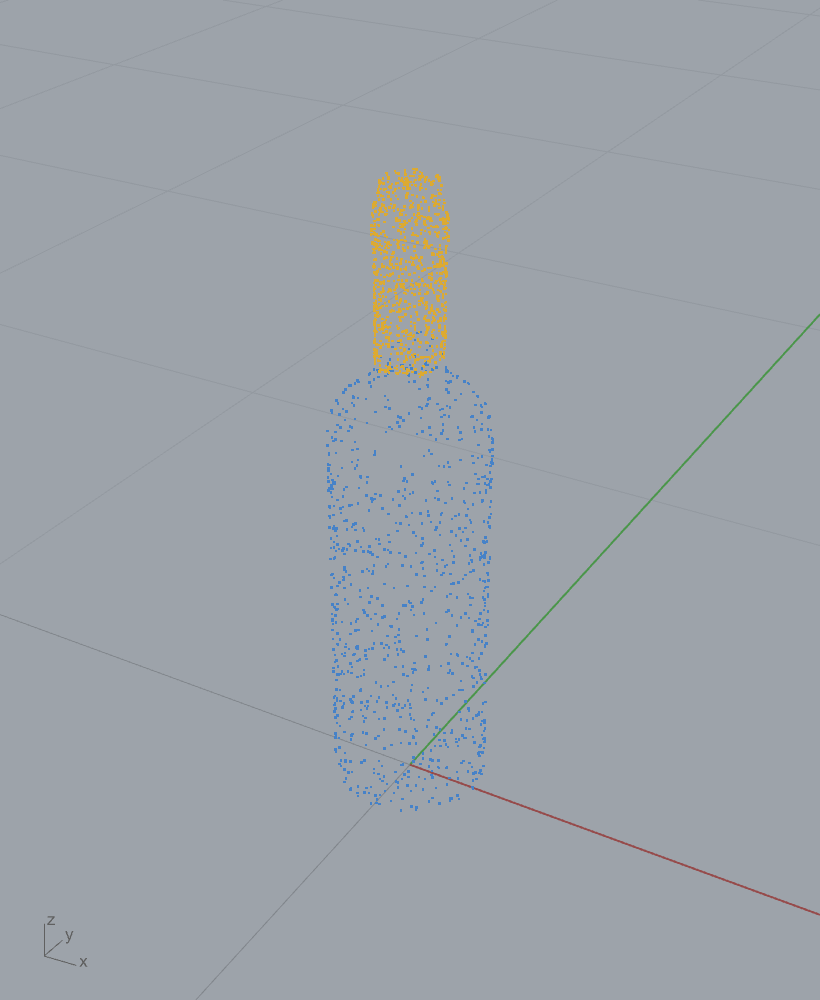
8. The projection bootstrap: unblocking the geometric 3D path¶
The geometric 3D path has a structural blocker, proved by run R0 and recorded on
the finder (ProjectionPairFinder.cs:16-22): independently tessellated shard
rims triangulate the shared cut differently, so the hash index finds zero
cross-panel complements (hash hits: self 172, cross-panel 0). The agglomerative
solver then has an empty pair graph and assembles nothing.
The key geometric fact that breaks the deadlock: for an open-shell shard the
naked rim along a cut facet lies in that facet plane, so two mating shards
share a plane, and per-facet projection reduces 3D rim matching to the working
2D matcher. The pipeline (ProjectionPairFinder.cs:23-48):
- Split and fit. Split each naked rim loop into maximal planar facet arcs;
fit each facet plane by PCA, taking the covariance
\(\Sigma=\tfrac1n\sum (x_i-\bar x)(x_i-\bar x)^\top\), its symmetric
eigendecomposition, the smallest-eigenvalue eigenvector as the normal, and
\(\sqrt{\lambda_{\min}}\) as the RMS out-of-plane residual
(
FitFacetPlane,:481-543). Low-planarity arcs are flagged and excluded. - Project and resample. Map each arc into its facet plane (
PlaneToPlane\(\to\) WorldXY) and resample at a scale-relative spacing, tessellation-invariant (:362-383). Build a 2DPanel. - Match in 2D. Run the working stages 1-4 across fragments to get complementary pairs and a 2D in-plane relative transform \(M_{2D}\).
- Lift to \(SE(3)\). The 2D match lifts to a 3D candidate pose
(
Lift,:607-619):
with \(\mathrm{Proj}_A=\mathrm{PlaneToPlane}(\text{facet}_A,\text{WorldXY})\) and \(\mathrm{Lift}_{B^{\flat}}=\mathrm{PlaneToPlane}(\text{WorldXY},\text{facet}_B^{\flat})\), where \(\text{facet}_B^{\flat}\) is the parent facet with its normal flipped so the lifted child facet normal is antiparallel to the parent's outward normal (opposite sides of the fracture).
8.1 Projection proposes, 3D disposes¶
A 2D shadow match has a normal-sign ambiguity, so both lift senses are tried
(flip the parent or flip the child, Lift vs LiftChildFlip, :621-636) and
each is verified in 3D: the symmetric mean nearest-neighbour distance between
the lifted child world arc and the parent world arc (Residual3D, :643-678).
A candidate whose 3D residual exceeds ProjectionVerifyFactor * objectScale
(default 12%) is a projection-ambiguous false positive and is dropped
(:268-270). This is the "projection proposes, 3D disposes" gate: a genuine
mating facet has a small 3D residual; a shadow match that lost depth has a large
one. Measured on the 6-shard fixture (roadmap, 2026-05-25): 67 cross-panel 2D
matches where R0 had 0, 25 lifted-and-3D-verified pairs, 6/6 fragments placed via
the agglomerative MST. The honest caveat is also recorded: the assembly is only
partially tight (2 of 5 MST interfaces fully in contact), so the bootstrap
proposes correctly but Soft-ICP does not yet tighten every edge.
Originality. original-research (A-candidate). The per-facet projection
bootstrap, the antiparallel lift composition, and the 3D-disposes verification
gate have no equivalent in the local corpus and no [Algorithm] attribute citing
an upstream source; the design basis is the in-repo
wiki/algorithms/edge_matching/projection_bootstrap_3d.md. A prior-art sweep is
pending, so per AGENTS.md §9 this is marked A-candidate, not asserted novel. The
PCA plane fit it builds on is clean-room textbook. Tier A.
9. The rigid-registration kernels¶
Two closed-form rigid-fit kernels live beside the matcher, and the chapter must keep them distinct.
Kabsch / SVD (the ICP kernel). ConstrainedIcp3D.Kabsch3D
(ConstrainedIcp3D.cs:147-189) and the Soft-ICP M-step use the
orthogonal-Procrustes SVD solve of section 4.2 on the vendored MathNet.Numerics
package. This is the per-iteration registration inside ICP (Besl and McKay 1992;
Kabsch 1976). clean-room algorithm over a vendored SVD.
Horn quaternion (the marker / georeference kernel).
RigidTransformRecovery (Frahan.StonePack.Core/Masonry/Geometry) solves the
same absolute-orientation problem by Horn's unit-quaternion method: build the
\(4\times4\) symmetric profile matrix \(N\) from the nine cross-covariance entries
(Horn eq. 25), take its largest-eigenvalue eigenvector as the optimal quaternion
via cyclic Jacobi, and read off \(R\) and \(t=\bar b-R\bar a\)
(RigidTransformRecovery.cs:6-30). It is pure-managed with no SVD
dependency and is exposed through the RegistrationApi facade
(RegistrationApi.cs:9-29, :57-108) and the georeference component
([Algorithm("Absolute orientation + UTM/EPSG transform", "Horn, B.K.P. (1987).
Closed-form solution of absolute orientation using unit quaternions...")],
GeoreferenceComponent.cs:36). clean-room implementation of Horn (1987).
The two kernels solve the identical least-squares problem
\(\min_{R,t}\sum\|Ra_i+t-b_i\|^2\) by two routes (SVD vs quaternion eigenproblem)
and agree numerically. The repository's own architecture audit flags this as a
keep-core duplication: three Horn/Kabsch absolute-orientation copies
(RigidTransformRecovery, the Georeference private Horn, and the
Kabsch3D/SoftIcpRefiner SVD) to be unified on one MathNet-SVD kernel. That is
a refactor item, not a correctness bug; both routes are correct.
10. Scale invariance¶
Real fragments span seven orders of magnitude: fracture aperture ~1.5-2 mm, Kintsugi/Trencadís shards 5-15 cm, dimension-stone blocks ~3 m, quarry blocks ~21 m, study areas km-scale. The same mating logic must hold at every scale, so every threshold is expressed as a fraction of object size, never an absolute millimetre. Concretely:
- A1 acceptance gates. The original residual gate was an absolute model-unit
distance, which rejects everything on a mm fracture and is meters of slack on a
100-unit block. The A1 increment makes it
\(\texttt{ResidualThresholdFactor}\times \text{objectScale}\)
(
AssemblyOptions.cs:67-75), objectScale being the combined bounding-box diagonal. Default 0 keeps the absolute gate, so existing behaviour is unchanged. - Soft-ICP. \(\tau_0\), the correspondence radius, the contact band, the
convergence translation, and the penetration tolerance are all multiples of the
median rim spacing or the object diagonal (
SoftIcpRefiner.cs:189-214,:277-278). - Projection bootstrap. Sample spacing, planarity flag, and the 3D-disposes
gate are fractions of the rim-loop diagonal
(
AssemblyOptions.cs:231-265).
The pattern follows the existing MeshContactDetector.adaptiveToleranceFactor
(5% of median edge). Benchmark errors are reported as fractions of object size so
metrics compare across the ~100-unit synthetic fixtures and the 5-15 cm real
objects.
11. The five-stage solver and the Trencadís case¶
The assembly solver runs the two modes declared on the options component
(EdgeMatchOptionsComponent.cs:31-32): the frame-anchored beam (the
original; every candidate is refined against panels already placed, growing from
an anchor, which suits the 2D Trencadís case where shards mate to a frame placed
first) and the agglomerative model (R0; match all pairs, build a weighted
pair graph, compose a minimum-residual spanning tree, which suits free 3D
reassembly where no single frame touches all shards). The two non-overlap
increments R1 (partial sub-segment emission so a long edge can reach the short
edge it mates with, BoundarySegmenter.cs:115-139) and R2 (an overlap penalty,
edge exclusivity, and a Jacobi depenetration polish, AssemblyOptions.cs:111-177)
drove the measured 2D overlap from 12-25% to 0% with 8/8 placed and 100% union
coverage (roadmap, 2026-05-25).
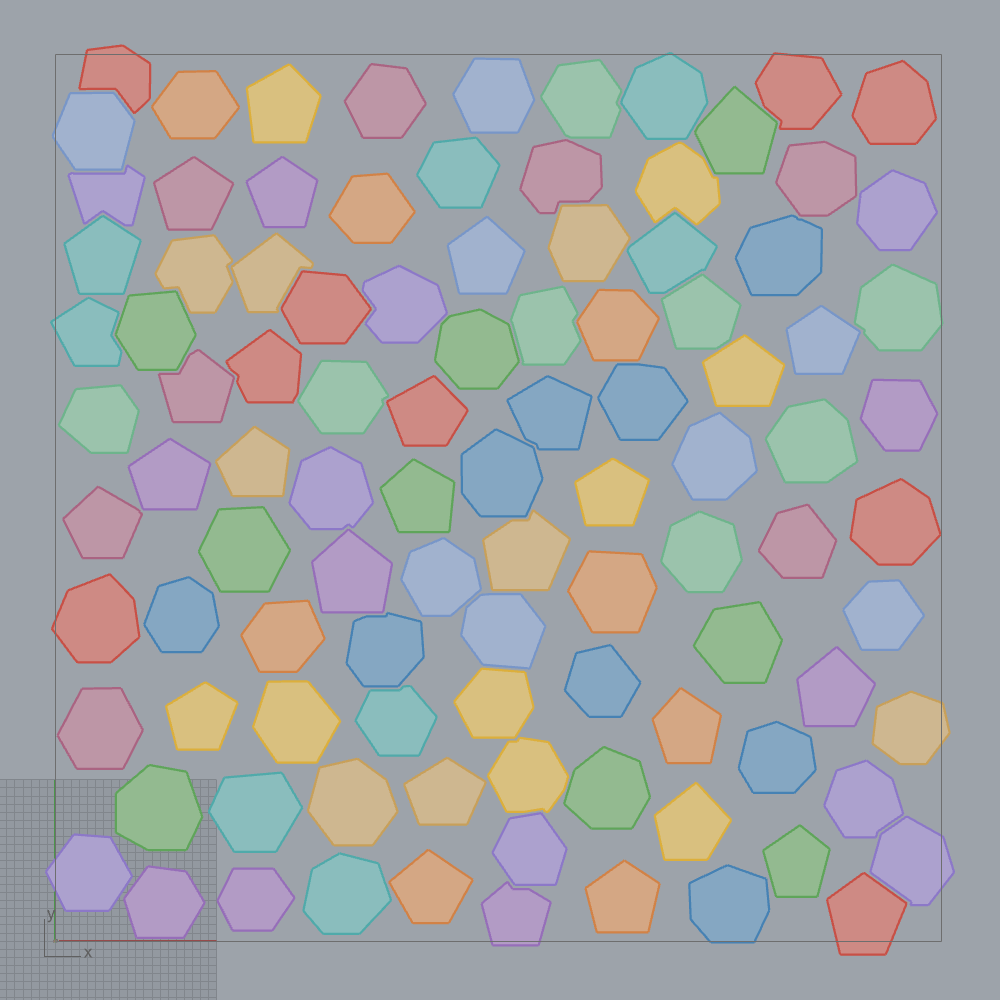
The Trencadís component is the geometric path's flagship: a centroidal-Voronoi
cell partition plus optimal one-to-one shard assignment, placing 28 irregular
shards into 28 cells with a grout gap, each piece used exactly once. The 3D
Block Pair Match component (GUID D5F10008) chains a variational shape
approximation segmenter, the 3D phase correlator, the constrained 3D ICP, and a
Hungarian assignment (BlockPairMatch3DComponent.cs:43-52); its VSA stage is a
stub (Cohen-Steiner, Alliez, Desbrun 2004 SIGGRAPH; Frahan stub
implementation, :43-45), and the component's own [RelatedComponent] points
users at the practically-tested Hungarian Stone-Cell Match for real stone-to-cell
work today (:41).
Status & what's left¶
- Geometric 3D reassembly is gated by tessellation. Independently tessellated rims produce zero cross-panel hash hits; the geometric 3D path only works through the projection bootstrap, which proposes correctly but leaves some MST interfaces loose. The tessellation-invariant path for production 3D is the learned Kintsugi Port (chapter on fragment learning), not this geometric engine. Severity high.
- VSA segmenter is a stub.
Block Pair Match 3Dstage 1 is a stub (BlockPairMatch3DComponent.cs:43-45); the component is honest about it and redirects to Stone-Cell Match. Severity medium. - Three duplicate absolute-orientation kernels. Horn-quaternion vs SVD-Kabsch (×2) solve the same problem; the architecture audit schedules unification on one MathNet-SVD kernel. Refactor, not a bug. Severity low.
- Documentation nits. The "Phase correlator FFT"
[Algorithm]name describes an FFT but the code is a direct \(O(n^2)\) circular correlation; harmless but should be reworded. Severity low. - Projection-bootstrap prior-art sweep pending. The bootstrap, antiparallel lift, and 3D-disposes gate are marked A-candidate; AGENTS.md §9 forbids asserting novelty without the sweep. Severity medium.
Originality summary¶
| Family | Class | Tier | Evidence |
|---|---|---|---|
| Boundary segmenter / turning descriptor | clean-room | B/C | EdgeMatchSolveComponent.cs:23; BoundarySegmenter.cs:151-189 |
| Segment hash index | clean-room (Frahan-original) | C | EdgeMatchSolveComponent.cs:24; SegmentHashKey.cs |
| Phase correlator | clean-room | C | EdgeMatchSolveComponent.cs:25; PhaseCorrelator.cs:13-44 |
| Constrained ICP (2D/3D) + SVD Kabsch | clean-room (algo) over vendored MathNet | B | EdgeMatchSolveComponent.cs:26; ConstrainedIcp3D.cs:147-189 |
| Order-preserving correspondence DP | clean-room | C | OrderedBoundaryMatcher.cs:24-37, :100-167 |
| Soft-ICP refiner (CPD + hinge) | clean-room / evolved-fork | B | SoftIcp3DComponent.cs:43-51; SoftIcpRefiner.cs:299-527 |
| Projection bootstrap | original-research (A-candidate) | A | ProjectionPairFinder.cs:16-48, :481-678 |
| Horn registration kernel | clean-room | B | RigidTransformRecovery.cs:6-30; GeoreferenceComponent.cs:36 |
References¶
- Arkin, E.M., Chew, L.P., Huttenlocher, D.P., Kedem, K., Mitchell, J.S.B. (1991). An efficiently computable metric for comparing polygonal shapes. IEEE Transactions on Pattern Analysis and Machine Intelligence 13(3):209-216. DOI 10.1109/34.75509.
- Bennell, J.A., Oliveira, J.F. (2009). A tutorial in irregular shape packing problems. Journal of the Operational Research Society 60(S1):S93-S105. DOI 10.1057/jors.2008.169.
- Besl, P.J., McKay, N.D. (1992). A method for registration of 3-D shapes. IEEE Transactions on Pattern Analysis and Machine Intelligence 14(2):239-256. DOI 10.1109/34.121791.
- Cohen-Steiner, D., Alliez, P., Desbrun, M. (2004). Variational shape approximation. ACM Transactions on Graphics (SIGGRAPH) 23(3):905-914. DOI 10.1145/1015706.1015817.
- Horn, B.K.P. (1987). Closed-form solution of absolute orientation using unit quaternions. Journal of the Optical Society of America A 4(4):629-642. DOI 10.1364/JOSAA.4.000629.
- Kabsch, W. (1976). A solution for the best rotation to relate two sets of vectors. Acta Crystallographica A 32(5):922-923. DOI 10.1107/S0567739476001873.
- Kuhn, H.W. (1955). The Hungarian method for the assignment problem. Naval Research Logistics Quarterly 2(1-2):83-97. DOI 10.1002/nav.3800020109.
- Marcotte, O., Suri, S. (1991). Fast matching algorithms for points on a polygon. SIAM Journal on Computing 20(3):405-422. DOI 10.1137/0220025.
- Myronenko, A., Song, X. (2010). Point set registration: Coherent Point Drift. IEEE Transactions on Pattern Analysis and Machine Intelligence 32(12):2262-2275. DOI 10.1109/TPAMI.2010.46.
- Tomczak, A., Haakonsen, S.M., Luczkowski, M. (2023). Matching algorithms to assist in designing with reclaimed building elements. Environmental Research: Infrastructure and Sustainability 3(3):035005. DOI 10.1088/2634-4505/acf341.
- Umeyama, S. (1991). Least-squares estimation of transformation parameters between two point patterns. IEEE Transactions on Pattern Analysis and Machine Intelligence 13(4):376-380. DOI 10.1109/34.88573.
- Wang, Z., Chen, B., Furukawa, Y. (2025). PuzzleFusion++: Auto-agglomerative 3D fracture assembly by denoise and verify. International Conference on Learning Representations (ICLR). arXiv:2406.00259.