Frahan StonePack



v0.1.0-alpha - experimental / research prototype. An independent open-source research implementation for stone / geometry-processing workflows in Grasshopper, under active development. This release is for public testing, feedback, and citation of the initial implementation. Not an official university or company product. Licensed GPLv3; bundles a non-commercial research-only component (Kintsugi / PuzzleFusion++) - see the License note below and
NOTICE.md. Cite viaCITATION.cff.
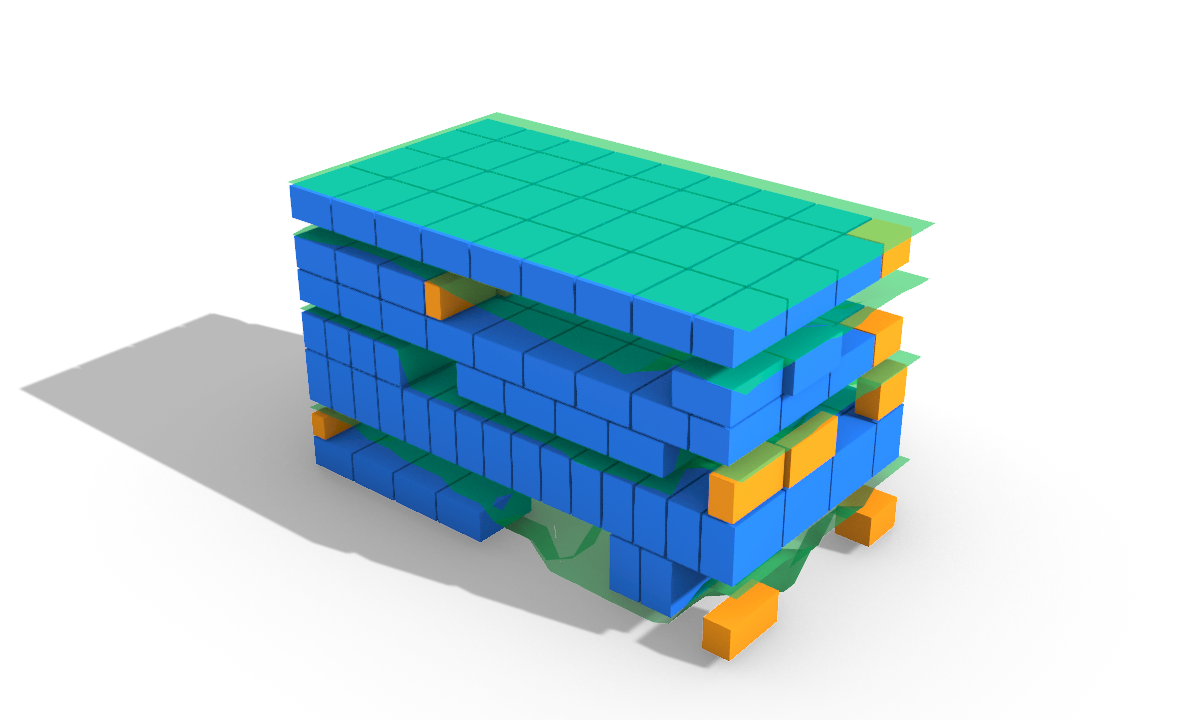
Fracture modelling -> wire-saw block packing: intact, saw-separable stock (blue/green) recovered from a fractured bench around the mapped fracture planes (green). The full GPR -> block-yield method is described in the paper preprint (doi.org/10.21203/rs.3.rs-10035624/v1). See docs/results/RESULTS.md for all benchmarks + process results, no Grasshopper required.
A Rhino / Grasshopper plugin for stone-fabrication readiness: the bridge layer between design intent and machine-ready fabrication for dimension stone, monuments, and dry-stone masonry. It covers the pipeline GPR / scan -> fracture mapping + point-cloud discontinuity / joint-set extraction -> 3D reconstruction -> discrete fracture network (DFN) -> block packing + cutting -> masonry assembly -> fabrication export, plus a research-grade algorithm library (2D/3D packing, hole-aware no-fit-polygon nesting, block-cut optimization, masonry equilibrium, edge-matching, surface mosaicing, joint-set + Baecher DFN).
License: GPL-3.0 (see LICENSE), released as a research preview for educational and research use.
The plugin bundles Frahan.Kintsugi.Port + kintsugi.bin, a port of PuzzleFusion++ whose authors permit
research use only (GPLv3 for research, not for commercial use) - so this distribution is for research /
education, not commercial use. A commercial-capable GPL-3.0 subset is obtainable by excluding the Kintsugi
module. Full attribution + per-component licenses: NOTICE.md, THIRD_PARTY_NOTICES.md, data/ATTRIBUTION.md.
How to cite: the software - Murugesan, L. (2026). Frahan StonePack (0.1.1-alpha). Zenodo.
https://doi.org/10.5281/zenodo.21228269 (machine-readable:
CITATION.cff); the method via the paper - Murugesan, L. (2026), A managed, uncertainty-aware
pipeline from ground-penetrating radar to dimension-stone block yield in fractured quarries,
Research Square preprint,
https://doi.org/10.21203/rs.3.rs-10035624/v1.
Quick start (users)
- Rhino 8 (Windows). Build
src/Frahan.StonePack.GH(net48) ->Frahan.StonePack.gha. - Close Rhino. File-copy the
.gha+Frahan.StonePack.Core.dll(and the E57 worker py + native libs) into%APPDATA%/Grasshopper/Libraries/. One.ghaonly. - Open Rhino + Grasshopper. The
Frahanribbon tab holds the component families. - Open an
examples/definition to see a full workflow on bundled sample data (data/).
Quick start (developers)
- See
docs/INSTALL.mdfor the toolchain (dotnet, RhinoCommon HintPath, the headlesstools/harness). - Build:
dotnet build src/Frahan.StonePack.GH/Frahan.StonePack.GH.csproj -c Release. - Test:
tests/Frahan.StonePack.Tests(xUnit-style runner; 1034 PASS / 0 FAIL / 147 SKIP as of 2026-06-14; skips = Rhino-runtime + optional-dataset gates). Headless packer benches:tools/Frahan.StonePack.Harness --packbenchand--pack2dstudy. - Read
AGENTS.md(orchestration rules) +handoffs/before contributing. ReadCONTRIBUTING.md.
Repository layout
src/— the 5 modules: Core, GH (.gha), Rhino (.rhp), EdgeMatching.Core, Kintsugi.Port (PuzzleFusion++ port, non-commercial research-only; seeNOTICE.md).tools/— headless harness + GPR bench.tests/— the test suite.examples/— master-spine workflows (.gh+.3dm+ README, referencingdata/).data/— sample datasets per workflow (seedata/ATTRIBUTION.md; LFS at the public step).wiki/— curated research:research/(SLM/PRISMA/ROSES studies, algorithm cards),algorithms/,specs/,papers/.research/— long-form math derivations + research-level coding context.handoffs/— human + agent onboarding,HANDOFF_LATEST.md,KNOWN_BUGS.md.install/— ready-to-deploy binaries: the.gha+ native libs (plugin/), Kintsugi Port weights (weights/kintsugi.bin, LFS), Breaking Bad parity samples (data/), BFF (tools/), anddeploy.ps1/deploy.sh. Rungit lfs pullthen the deploy script (Rhino closed). Seeinstall/INSTALL.md.docs/— install, build, deploy, architecture.
Results at a glance (no Grasshopper required)
See docs/results/RESULTS.md for the measured benchmark + process figures: the 2D stock-utilization study (evolved NFP-BLF crosses the 80% bar at 0 overlap with holes), the hole-aware nester (HoleNest / ContactNfpHoleNester) head-to-head vs the OpenNest reference physics nester, the 3D volumetric ratios (Dlbf best-of-orientation 70.4%), the fracture recovery / block-packing captures, and the masonry/quarry decision. Test battery (2026-06-14): 1034 PASS / 0 FAIL / 147 SKIP from a clean clone (skips = Rhino-runtime + optional-dataset gates).
What makes it research-grade
Every kept algorithm has a measured benchmark, a math derivation (SLM tier), a statistics review (PRISMA),
and an interdisciplinary synthesis (ROSES). Example: the 2D nester crosses the 80% stock-utilization bar at
0 overlap with holes; the studies are in wiki/research/.
Formally verified algorithm core
The algorithm derivations are machine-checked in Lean 4 + Mathlib (frahan_proofs/):
every named result of the derivations spec is proved or explicitly documented prose — zero sorry, zero
open goals, one cited axiom (KKT necessity, audited with a counterexample-driven fix), CI-enforced.
Highlights: the trim/clip theorems, no-fit-polygon separation (the nester's zero-overlap guarantee),
Welsh–Powell Δ+1 coloring built from scratch, and the full Graham 1969 LPT 4/3 − 1/3m scheduling bound
— closed by replacing the classical exchange induction with a static pigeonhole argument. The proofs are
tied back to the shipping C#: property-based verification tests exercise the real kernels against the same
machine-checked invariants (two real bugs were found and fixed this way — a coincident-plane clip volume
inflation and a graph-coloring palette cap). See frahan_proofs/README.md for
the theorem table.
Contact
Questions, a collaboration, or a walkthrough of the plugin? Book a meeting (Calendly).