07. Surface Packing & Conformal Unwrapping
This chapter covers the Surface Packing ribbon tab: the pipeline that takes a curved 3D stone surface, flattens it to a planar chart, packs parts into that flat chart, and lifts the packed parts back onto the curved surface. It is the freeform-cladding spine of the toolkit: a Trencadis mosaic, a tile field, or any 2D part set can be draped onto a sculpted face so the pieces follow the surface and butt edge to edge in 3D.
The subsystem is deliberately split across a process boundary. The hard
mathematics, conformal planar parameterization, is done by an external solver,
Boundary First Flattening (Sawhney and Crane 2017), shipped as a single static
executable. Everything Frahan owns sits around that solver: a seam-correct flat
mesh build, a global chart-scale recovery, an edge-stretch distortion metric, and a
barycentric inverse map that pulls packed UV curves back to 3D. The 2D packing
itself was recently re-pointed from the legacy V506 nester onto the deterministic
hole-aware engine (ContactNfpHoleNester), so the surface components inherit
0-overlap-by-construction layouts and a live async canvas.
The Core lives at src/Frahan.StonePack.Core/SurfacePacking (Rhino-free where it
can be: the inverse map and the chart record still use Rhino.Geometry). The
Grasshopper front end lives at src/Frahan.StonePack.GH/SurfacePacking.
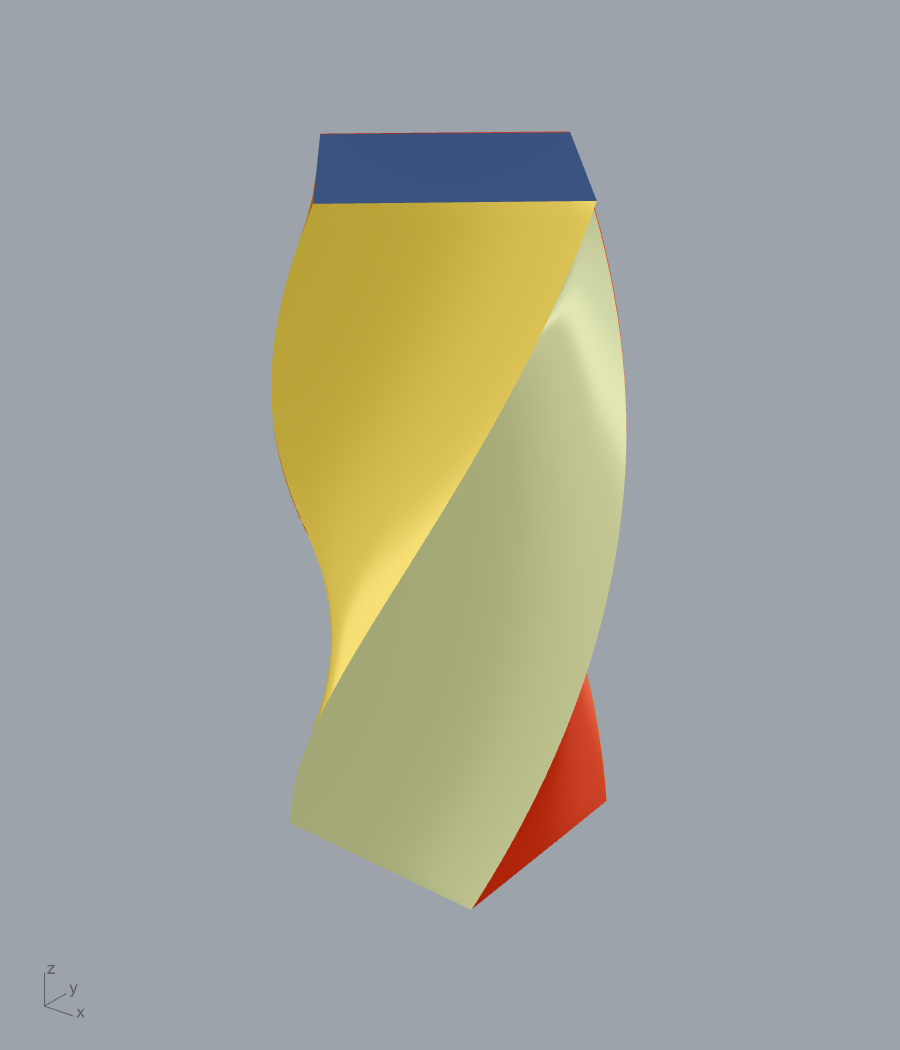
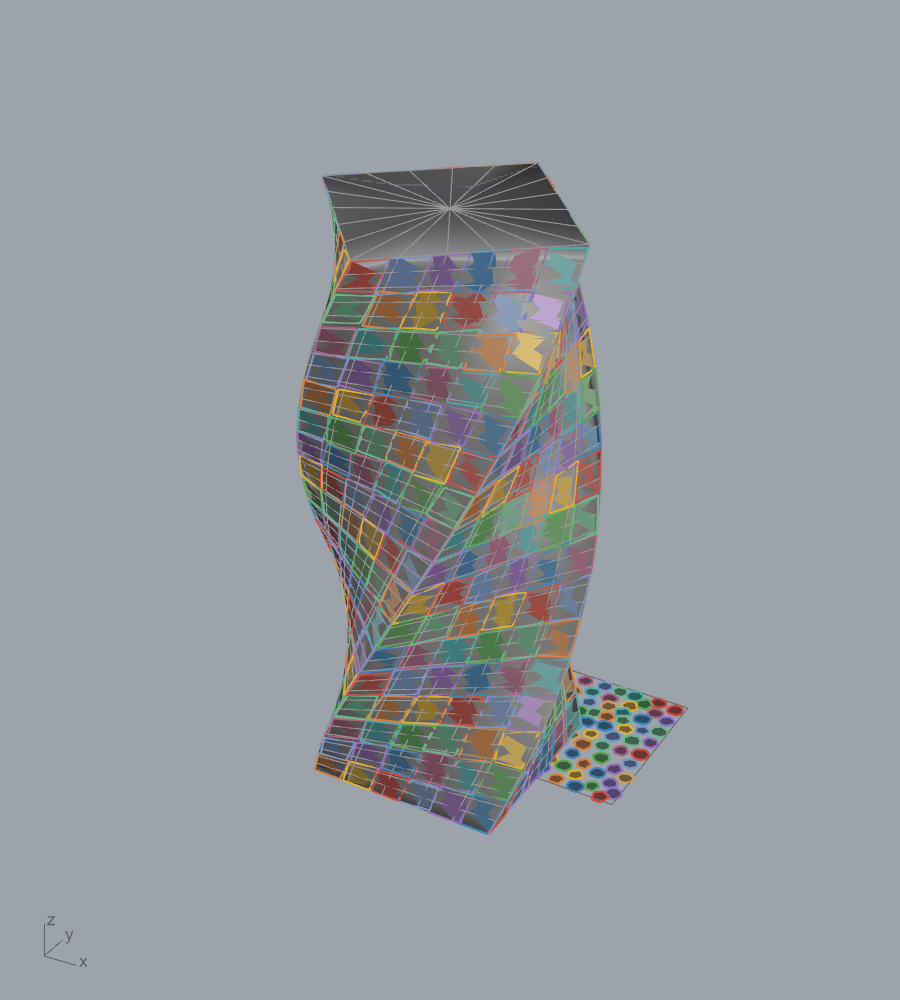
Example 13: a twisted monument (130 deg over its height) is split by CGAL dihedral segmentation into 6 regions, then a 176-shard Trencadis mosaic is mapped onto the curved surface through the BFF chart and the barycentric inverse map.
7.1 The pipeline at a glance
The forward chart is built by SurfaceChartComponent.ComputeChart
(SurfaceChartComponent.cs:217). The ten steps are:
- Clean and triangulate the input mesh (
MeshCleanup). - Write an OBJ, splitting quads into two triangles (
MeshObjIO). - Run the external BFF binary (
BffCommandLineRunner). - Parse the output OBJ into a per-(face, corner) UV table (
FaceCornerUvTable). - Build an unwelded flat mesh: three fresh vertices per triangle so UV seams are never bridged.
- Recover a single global scale (
ChartScaleComputer). - Scale the flat mesh to real units.
- Compute the edge-stretch distortion report (
ChartDistortionAnalyzer). - (Downstream) pack parts into the flat chart with
ContactNfpHoleNester. - (Downstream) inverse-map packed 2D curves to 3D by barycentric blend
(
BarycentricMapper2DTo3D).
The load-bearing invariant across the whole pipeline is that face i in the flat
mesh corresponds exactly to face i in the 3D surface mesh. Every chart-scale,
distortion, and inverse-map computation relies on this index alignment. The
FrahanSurfaceChart record (FrahanSurfaceChart.cs:12) carries the immutable
result: the original 3D mesh, the scaled flat mesh, the scalar chart scale, the
flat outer boundary polyline, and the distortion report.
7.2 Conformal flattening (BFF, external)
7.2.1 The mathematics BFF solves
Boundary First Flattening (Sawhney and Crane 2017) computes a discrete conformal map from a triangle mesh with disk topology to the plane. A conformal map preserves angles, so a flattening is conformal when its differential is, locally, a rotation composed with a single positive scaling. Equivalently the map distorts lengths by a scalar conformal factor \(e^{u}\) that varies over the surface but applies isotropically at each point:
The factor \(u\) is governed by the Yamabe equation, which relates the change in Gaussian curvature to the Laplacian of \(u\):
where \(K\) is the original Gaussian curvature and \(\tilde{K}\) the target. For a flat chart \(\tilde{K}=0\) in the interior, so the interior curvature must be absorbed and all the cone defect pushed to the boundary or to a small set of cone singularities. The Sawhney-Crane contribution is to pose this as a boundary problem: prescribe either the boundary scale factor \(u|_{\partial M}\) or the geodesic curvature \(\tilde{k}|_{\partial M}\), then recover the other via a Dirichlet-to-Neumann map built from a Cherrier-type linear system, and finally integrate the curve and extend it to the interior with two harmonic conjugate functions. The dense work is a sparse Cholesky factorization (SuiteSparse) of the cotangent-Laplace operator; the boundary solve is cheap once that factorization exists.
The chapter does not reimplement these equations. The BFF kernel is not in this
repository. Frahan calls it as a process: bff-command-line.exe "<in.obj>"
"<out.obj>" [--nCones=K] [--normalizeUVs] (BffCommandLineRunner.BuildArgs,
BffCommandLineRunner.cs:101). The cone count \(K\) exposes the cone-singularity
extension, and --normalizeUVs rescales the output UVs to a unit box, which is why
Frahan must then recover the real-world scale itself (Section 7.3).
7.2.2 Static single-exe build
The shipped artifact is a static bff-command-line.exe: 17 third-party DLLs
folded into one 38 MB executable with only KERNEL32 and msvcrt imports
(install/tools/BFF-BUILD-STATIC.md). The build links SuiteSparse (CHOLMOD, UMFPACK,
AMD/COLAMD), OpenBLAS with its bundled static LAPACK, and GFortran statically with a
single g++ invocation under MSYS2 mingw64, skipping the GUI app and the
non-essential submodules. The -Wl,--start-group ... --end-group link group
resolves the circular SuiteSparse-to-BLAS static references. The build recipe
records that the output UV is byte-identical to the upstream dynamic build, which is
the parity check that lets the static exe be treated as the same tool. This swap was
made because the multi-DLL deploy was breaking; the commit is
d1b5c5b ("static single-exe BFF — 17 DLLs -> 1 self-contained exe").
7.2.3 Async wrapper and pipe-deadlock handling
BffCommandLineRunner.RunAsync (BffCommandLineRunner.cs:32) runs the process with
stdout and stderr consumed asynchronously on separate handlers, which is the correct
way to avoid the classic pipe deadlock where a child fills its OS pipe buffer while
the parent blocks on WaitForExit. A CancellationTokenSource enforces the timeout
and kills the process on overrun. The component (SurfaceChartComponent) is a
GH_TaskCapableComponent: the whole solve runs on a pool thread so the BFF process
launch never blocks the Grasshopper UI thread.
Originality. The BFF flattening kernel is third-party. The component that wraps it is a wrapper-of-native with a small clean-room orchestration shell around it.
- Evidence (kernel):
[Algorithm("BFF boundary-first flattening", "Sawhney and Crane 2017, ACM TOG 36(4):109", Doi="10.1145/3072959.3056432", Note="External BFF command-line exe; Frahan wraps the binary")]atSurfaceChartComponent.cs:43. - Evidence (process boundary):
BffCommandLineRunner.RunAsyncshells out only;wiki/research/slm_cards/bff-surface-flatten.mdstates "the conformal flattening math (Sawhney-Crane 2017) lives entirely inside an external binary." - Licence note: BFF ships under its upstream MIT-style licence; SuiteSparse,
OpenBLAS, and GFortran notices are owed in the dist
NOTICE(see the build recipe).
7.3 Chart-scale recovery (Frahan, clean-room)
BFF run with --normalizeUVs returns UVs in a unit box. To turn the chart into a
fabrication template, the flat mesh must be rescaled to real-world surface
distances. ChartScaleComputer.ComputeGlobalScale (ChartScaleComputer.cs:14)
recovers a single isotropic scalar as the ratio of total 3D edge length to
total flat edge length, summed over all triangular faces. For the triangle set \(F\),
with surface-triangle vertices \(s^i_A, s^i_B, s^i_C\) and flat-triangle vertices
\(f^i_A, f^i_B, f^i_C\):
The denominator is guarded against degeneracy: if \(\sum f\text{-edges} < 10^{-12}\) or
no valid triangle was found, the method returns \(s = 1\) with a warning
(ChartScaleComputer.cs:52). The scale is then applied to the flat mesh by a
uniform Transform.Scale (SurfaceChartComponent.cs:285), so FrahanSurfaceChart.FlatMesh
is stored post-scale in real units. Downstream packing consumes it directly with
no further scaling.
Derivation and its limitation. Why a length ratio rather than an area ratio? On a conformal map the local length scale is \(e^{u}\) and the local area scale is \(e^{2u}\). Taking the ratio of total perimeters rather than total areas keeps the recovered \(s\) a length scale, so it composes directly with edge-length distortion in Section 7.4. But \(u\) is not constant over a curved surface (that is the whole point of a conformal map: it trades angle preservation for spatially varying area scale). A single global \(s\) is therefore the perimeter-weighted average of \(e^{u}\) over the chart, and it mis-sizes parts wherever the local conformal factor departs from that average. This is the central accuracy compromise of the subsystem and is documented as an evolution target (per-face or per-cone-patch scale) in the SLM card.
Originality. ChartScaleComputer is clean-room Frahan math: a global
scale recovery derived from the conformal-factor structure, with no upstream code.
- Evidence:
[Algorithm("Conformal chart-scale recovery", "Frahan-original barycentric UV-to-real-world scaling")]atSurfaceChartComponent.cs:44; full derivation inwiki/research/slm_cards/bff-surface-flatten.md. - Tier: B (faithful, derivable; the single-global-scale approximation is the known limitation, not a novelty claim).
7.4 Edge-stretch distortion metric (Frahan, clean-room)
A fabrication template is only trustworthy if its distortion is bounded.
ChartDistortionAnalyzer.Analyze (ChartDistortionAnalyzer.cs:27) measures
edge-scale distortion (not area) because cut-path accuracy depends on length,
not on enclosed area. The flat vertices are first scaled by \(s\), then for each
triangle edge \(e\) joining endpoints \(p, q\) the stretch ratio is:
Edges with either endpoint distance below \(10^{-8}\) are skipped
(ChartDistortionAnalyzer.cs:96). The report warns when
\(\sigma_{\max} > 1.15\) (high stretch, increase clearance) or
\(\sigma_{\min} < 0.85\) (high compression, parts under-scaled after mapping); the
thresholds are constants at ChartDistortionAnalyzer.cs:24.
For a perfectly conformal BFF map \(\sigma_e \to e^{u}/s\) varies smoothly with the local conformal factor, which is exactly why \(\sigma_{\max}\) and \(\sigma_{\min}\) bracket the spread of \(e^{u}\) around the global average \(s\). The metric therefore serves two roles: it is the fabrication-trust gauge, and it is the diagnostic that a single global scale is or is not adequate for a given chart.
A complementary symmetrized flatness classifier lives in ChartFlatnessReport:
given a per-face area ratio \(r_i\) it forms
with \(r_i \le 0 \Rightarrow \rho_i = \infty\) (ChartFlatnessReport.cs:93). This is
a pure-managed area-distortion symmetrization with no Rhino dependency.
A known blind spot. Because \(\sigma_e\) uses scalar lengths, it cannot see a foldover: a flat triangle whose orientation BFF flipped still passes the edge-stretch test (lengths ignore sign). Detecting foldovers needs a signed-area sign test per flat triangle, which is logged as an evolution item (flag M3).
Originality. ChartDistortionAnalyzer and ChartFlatnessReport are
clean-room Frahan metrics derived from the conformal-factor structure.
- Evidence: derivation at
wiki/research/slm_cards/bff-surface-flatten.md(sections "Edge-stretch distortion" and "Flatness classifier"); no upstream code, both are pure managed. - Tier: B.
7.5 Seam-correct flat mesh (Frahan, clean-room)
A conformal chart of a non-trivial surface needs seam cuts to open the surface
into a disk. Across a seam, one shared 3D vertex maps to two different UV
positions. A naive welded mesh would average those, bridging the seam and corrupting
the chart. FaceCornerUvTable (FaceCornerUvTable.cs:37) solves this by keying UVs
on (faceIndex, cornerIndex) rather than on vertex index, so each face corner
carries its own UV. ToFlatUnweldedMesh (FaceCornerUvTable.cs:56) then emits
three fresh vertices per triangle:
- For triangle \(i\) it reads the three corner UVs \((u_A, v_A), (u_B, v_B), (u_C, v_C)\).
- It adds three new flat vertices at those UV positions in the \(Z=0\) plane.
- It adds one face on the new vertices, preserving face index \(i\).
- A missing UV throws
InvalidOperationExceptionrather than defaulting to \((0,0)\), so a parse bug surfaces immediately instead of silently corrupting one corner.
The output is intentionally non-manifold (three vertices per triangle), which is
correct for seam handling but means boundary extraction must use naked-edge tracing.
FrahanSurfaceChart.ExtractOuterBoundary (FrahanSurfaceChart.cs:58) calls
GetNakedEdges and takes the longest loop as the outer boundary; the shorter
loops are sheet holes. The custom FaceCornerKey.GetHashCode uses
(FaceIndex * 397) ^ CornerIndex to avoid boxing on net48, consistent with the
repo build constraints.
Originality. Clean-room Frahan engineering. The SLM card flags the unwelded-flat + face-corner-UV table as "genuinely correct and non-trivial". No upstream code.
- Evidence:
FaceCornerUvTable.cs:56;wiki/research/slm_cards/bff-surface-flatten.mdstep 5. - Tier: C-to-B (correct, non-trivial seam engineering).
7.6 Barycentric inverse map (Frahan, clean-room) — and a citation correction
After parts are packed into the flat chart, their 2D curves must be lifted back to
the 3D surface. BarycentricMapper2DTo3D (BarycentricMapper2DTo3D.cs:25) samples
each packed curve to a polyline, then maps each sample point.
For a query point \(p\) and a flat triangle \((a, b, c)\), with \(v_0 = b - a\), \(v_1 = c - a\), \(v_2 = p - a\) and the 2D Gram matrix entries \(d_{00} = v_0\!\cdot\!v_0\), \(d_{01} = v_0\!\cdot\!v_1\), \(d_{11} = v_1\!\cdot\!v_1\), \(d_{20} = v_2\!\cdot\!v_0\), \(d_{21} = v_2\!\cdot\!v_1\), Cramer's rule on the normal equations gives the barycentric weights:
The triangle is rejected as degenerate when \(|D| < 10^{-12}\)
(BarycentricMapper2DTo3D.cs:158); containment is accepted when
\(w_A, w_B, w_C \ge -10^{-6}\) (BarycentricMapper2DTo3D.cs:164). The 3D position
applies the same weights to the corresponding surface triangle
(BlendSurfacePoint, BarycentricMapper2DTo3D.cs:168):
This is correct precisely because of the face-index invariant: weights computed on
flat face \(i\) are valid on surface face \(i\). For sample points that fall just
outside the chart boundary (a common artefact of sampling a curve that runs along
the boundary), a fallback uses Mesh.ClosestMeshPoint(p, 5 \times \text{samplingTol})
and reuses Rhino's returned barycentric weights mp.T
(BarycentricMapper2DTo3D.cs:124). The search is a linear \(O(P \cdot F)\) scan over
all flat faces, which the author flags as "acceptable for mesh densities < ~2000
faces"; an RTree is the documented scale-up.
A misattributed citation
The [Algorithm] attribute on PackOnSurfaceComponent.cs:41 cites this lift as
"Floater 2003 ... Mean value coordinates" (Doi=10.1016/S0167-8396(03)00002-5).
The shipped code does not implement mean-value coordinates. It implements plain
triangle barycentric interpolation (Cramer's rule on the 2D Gram system above),
which is the classical piecewise-linear inverse map, not Floater's generalized
barycentric coordinates for polygons. The audit ground truth is explicit:
"Inverse map = standard barycentric interpolation. NO Floater-2003 MVC code present"
(wiki/research/slm_cards/bff-surface-flatten.md:6). The correct attribution for
the implemented method is classical barycentric interpolation over a triangle mesh;
Floater (2003) stands here only as related background for the mean-value-coordinate
family, not as the implemented method. This is a citation-correctness flag, not a
code defect: the math that ships is correct, it is simply not the cited method.
Originality. Clean-room classical barycentric interpolation. The method is textbook; the contribution is the seam-correct, face-index-aligned plumbing that makes it a reliable inverse for a BFF chart. It is reusable for any triangle-to-triangle chart, not only BFF output.
- Evidence:
BarycentricMapper2DTo3D.cs:141-179; citation flag atwiki/research/slm_cards/bff-surface-flatten.md:6. - Tier: C (commodity math), with a B-grade reuse seam.
7.7 The packing engine swap: V506 → HoleNest
The two packing components, Pack On Surface and Pack Surfaces, were
recently rewritten to drop the legacy V506 nester and call the deterministic
hole-aware Core engine ContactNfpHoleNester (the CNH family). The commit is
05c7e82 ("feat(surface): Pack Surfaces + Pack On Surface onto HoleNest engine +
self-trigger async"). Both components kept their ComponentGuid so existing
canvases keep resolving them: B7E4D9C1-3F8A-4B2E-91C6-5D7F3A8B2E1D (Pack On
Surface) and C4A8D2E1-7F3B-4C5D-9A2E-6B8D4F1E3C7A (Pack Surfaces).
What the swap buys
The hole-aware engine builds no-fit and inner-fit polygons exactly as Clipper2 Minkowski operations and places by bottom-left-fill. For a part and an obstacle the no-fit polygon is the Minkowski sum of the obstacle with the reflected part:
the inner-fit polygon is the Minkowski erosion of the container by the part:
and the feasible placement region for a part on the flat chart sheet is the inner-fit region minus the union of no-fit regions against every placed part and every sheet hole:
The placement is the bottom-left vertex of the feasible region; every accepted move
is re-checked by a compound boolean-area-plus-penetration-depth gate, so the layout
is 0-overlap by construction (ContactNfpHoleNester.cs:27-72). For the surface use
case this matters directly: a chart's inner naked edges become sheet holes, and
parts route around them rather than being placed on top of a chart gap. The previous
V506 path did not do hole-aware nesting on the chart.
The surface components feed the engine through a single shared bridge,
SurfaceHoleNestBridge (SurfaceHoleNestBridge.cs:21), so the curve-to-loop logic
lives in exactly one place. The bridge does uniform-by-length sampling for smooth
curves (curvature-adaptive sampling makes degenerate tiny edges that slow the
Minkowski NFPs), measures the sampling proxy deviation so the engine spacing can
be inflated to keep full-resolution output non-overlapping, enforces CCW orientation
(the Core nester expects CCW loops), and rejects any curve that is not
WorldXY-parallel (a tilted curve would nest a foreshortened projection).
Distortion-aware spacing
Because the chart is conformal (area-varying), parts that just clear in the flat
chart can butt closer on the 3D surface where the local scale is larger. Pack On
Surface compensates by inflating the user clearance by the chart's max edge
stretch (PackOnSurfaceComponent.cs:400):
then adds the proxy-deviation term before handing the engine its spacing:
where \(\delta_{\text{part}}\) and \(\delta_{\text{sheet}}\) are the worst sampled
deviations of the part and sheet proxies (PackOnSurfaceComponent.cs:424). The part
term enters with factor 2 (part-pair clearance needs both parts' deviation); the
sheet term enters once. Pack Surfaces uses the same proxy-deviation compensation
without the stretch inflation (PackSurfacesComponent.cs:539), because it emits a
rigid placement frame per part and reports the surface gap directly (below).
Fabrication outputs
Pack Surfaces is the multi-chart, fabrication-grade component. It packs across
one or more charts with greedy overflow (chart 0 fills first, unplaced parts
carry to chart 1), and per placed part it emits a rigid placement frame computed by
sampling the surface at the part centroid and at small \(x\) and \(y\) offsets to build
local tangent axes (ComputePlacementFrame, PackSurfacesComponent.cs:613). The
frame yields three fabrication transforms:
- Transforms 3D (T3): from the packed 2D position to the 3D placement frame.
- Full Transform (FT): composed
T3 \cdot packTx, mapping the original flat part straight to its surface position in one step (PackSurfacesComponent.cs:425). - Max Deviation: the largest gap between the flat part and the curved surface,
measured at the four bounding-box corners against the placement plane
(
PackSurfacesComponent.cs:655). Small means nearly flat; large means the piece needs shimming or sub-tiling.
The rigid-frame path is the honest fabrication answer: a flat-cut stone part cannot deform, so the FT transform places it rigidly and Max Deviation quantifies the residual gap, rather than pretending the part bends to the surface.
Self-trigger async
Both components run the solver and the 3D mapping on a background Task so the
canvas never freezes; the previous result stays visible while a new layout computes,
progress text ticks live, and the finished result pops in via ScheduleSolution. A
_selfTrigger flag distinguishes the component's own scheduled re-solves (emit only)
from real GH input changes (rebuild and restart), and a sampling-free bounding-box
input hash guards against redundant recomputes (PackSurfacesComponent.cs:541,
PackOnSurfaceComponent.cs:426). The pattern follows the repo async-source rule and
the AsyncScanComponent gate: if Run flips false inside the +10 ms schedule window,
the component clears rather than repainting a stale layout
(PackSurfacesComponent.cs:235). Several legacy V506-only inputs (Sort Mode, Corner
Mode, Seed, Max Candidates) are kept in their original slots for wiring compatibility
but are now inert under the deterministic engine and documented as ignored.
Originality (the engine). ContactNfpHoleNester is clean-room from
published NFP and BLF mathematics, with a measured evolved-fork increment
(contact-adaptive rotations and part-in-part-hole inner-fit nesting) over plain
bottom-left-fill.
- Evidence:
[Algorithm("Exact No-Fit-Polygon Bottom-Left-Fill with part-in-part-hole nesting", "Burke ... 2006 ...", Doi="10.1287/opre.1060.0293")]and[Algorithm("No-fit-polygon / inner-fit-polygon via Minkowski sum", "Bennell & Oliveira 2009 ...", Doi="10.1057/jors.2008.169")]atHoleNestComponent.cs:25-31; the Clipper2 back end (HoleNestComponent.cs:32, BSL-1.0, no copyleft); the contact-rotation increment[Algorithm("Contact-adaptive rotations ... Frahan ContactNfpHoleNester evolution study, outputs/2026-06-12/hole_packer_evolution", Note="Frahan-original ...")]atHoleNestComponent.cs:34. The engine and the contact/IFP delta are covered in their own 2D-packing chapter; here it is a consumed dependency.
Originality (the two surface components). Both are
facade-over-primitives: they compose the BFF chart, the
SurfaceHoleNestBridge curve-to-loop, the ContactNfpHoleNester engine, and the
BarycentricMapper2DTo3D lift behind one canvas box. They add no new algorithm; the
distortion-aware spacing and the rigid placement frame are derivable plumbing over
those primitives.
- Evidence:
PackOnSurfaceComponent.cs:43(GH_ComponentcomposingContactNfpHoleNester.PackSheets+BarycentricMapper2DTo3D),PackSurfacesComponent.cs:56; the swap commit05c7e82.
7.8 Status & what's left
The subsystem is live-validated in example 13 (segmentation plus surface-conformal
Trencadis, captured and pre-baked). The engine swap onto HoleNest is committed
(05c7e82) and the static BFF exe is committed (d1b5c5b). The open items, ordered
by severity, are:
-
Floater 2003 citation is wrong (medium).
PackOnSurfaceComponent.cs:41credits "Floater 2003 mean value coordinates", but the code is plain triangle barycentric interpolation; no MVC code exists. Soften to related-work or replace with a classical barycentric citation. The math that ships is correct. -
Single global chart scale mis-sizes parts (medium). A conformal map has a spatially varying area scale; one isotropic \(s\) is the perimeter-weighted average and is wrong wherever the local conformal factor departs from it. The fix is per-face or per-cone-patch scale plus adaptive re-cut driven by the flatness metric (
ChartScaleComputer.cs:58). -
Inverse map is \(O(P \cdot F)\) (medium). The linear triangle scan caps at the author-stated ~2000 faces (
BarycentricMapper2DTo3D.cs:107); an RTree over flat face bounding boxes turns it into \(O(P \log F)\) and removes the ceiling. -
Foldover blind spot (medium). Edge-stretch uses scalar lengths and cannot see a BFF triangle flip (
ChartDistortionAnalyzer.cs:98); add a per-face signed-area sign test. -
Tolerance and units unresolved (medium). At least four absolute epsilons (\(10^{-6}\) containment, \(10^{-8}\) edge skip, \(10^{-12}\) denominator and scale guards) plus a default sampling tolerance of \(0.01\), none scaled to chart size, and no model unit recorded in
FrahanSurfaceChart(flags T1, T2, T4, T5, T7 in the SLM card). This violates the standing mm-versus-m scale-invariance constraint: the same chart silently means a different physical size in a mm versus an m document. -
Far-from-origin precision (low). The OBJ is written with raw world coords at G10; a UTM-scale chart loses mantissa bits on disk and in the Gram products. A recenter-before-write and undo-after-map is the fix (flag T1).
None of these are fatal: the pipeline produces correct, pre-baked output today. They are the bounded edits between "works on the example" and "fabrication-grade at arbitrary scale and units".
References
- Sawhney, R. and Crane, K. (2017). Boundary First Flattening. ACM Transactions on Graphics 36(4):109. DOI 10.1145/3072959.3056432.
- Floater, M.S. (2003). Mean value coordinates. Computer Aided Geometric Design 20(1):19-27. DOI 10.1016/S0167-8396(03)00002-5. (Related background for the mean-value-coordinate family; the shipped surface lift is plain triangle barycentric interpolation, not Floater's polygon MVC. See Section 7.6.)
- Burke, E.K., Hellier, R., Kendall, G. and Whitwell, G. (2006). A New Bottom-Left-Fill Heuristic Algorithm for the Two-Dimensional Irregular Packing Problem. Operations Research 54(3):587-601. DOI 10.1287/opre.1060.0293.
- Bennell, J.A. and Oliveira, J.F. (2009). A tutorial in irregular shape packing problems. Journal of the Operational Research Society 60(S1):S93-S105. DOI 10.1057/jors.2008.169.
- Johnson, A. Clipper2. Boost Software License 1.0. (Minkowski sum + NonZero Boolean back end for the NFP/IFP construction.)