03. Quarry Block-Cutting Optimization
3.0 Scope and lineage
This chapter covers the Quarry ribbon tab subset built on the BlockCutOpt
engine: the pose-sweep solver, its recovery and yield objective, the Jalalian
cutting-surface-area-per-value cost axis, the multi-scale recovery cascade, and
the downstream flat-versus-oblique guillotine and gangsaw cost frontier studied
in examples 08, 24, and 25. The core lives at
src/Frahan.StonePack.Core/Masonry/Quarry/BlockCutOpt. The managed solver is a
clean-room reimplementation of the BlockCutOpt brute-force algorithm
(Elkarmoty et al. 2020), whose original implementation is private C++
(BlockCutOpt/README.md:46-50). The repository's tracked delta is documented as
the "14 improvements" table (README.md:185-198), of which 12 of 14 are shipped
(README.md:200). Per the originality framework, the base solver is
clean-room (published math, no upstream source in the tree); the I1 full-3D
pose, the I6/I11 Pareto/BCSdbBV axes, and RecoveryCascade are the
evolved-fork increments claimed in the submitted BoEGE paper
(Murugean 2026, Zenodo DOI 10.5281/zenodo.20608279).
The geological front end (the GPR fracture chain that feeds the tested area) is covered in the GPR chapter; here we take the fracture mesh as given input.
3.1 The block-cut objective: recovery over a pose space
3.1.1 Problem statement
A quarry bench is an axis-aligned tested region \(\mathcal{A}\subset\mathbb{R}^3\). The rock contains a discontinuity set represented as a triangle soup \(\mathcal{F}=\{T_k\}\) (the fan-triangulated fracture mesh). A cutting grid lays out candidate commercial blocks of fixed size \((L_x,L_y,L_z)\) on a regular lattice. A block is marketable only if it is crossed by no fracture. The decision variables are the rigid pose of the lattice: the yaw \(\psi\) about the vertical axis, the optional tilts \(\theta,\phi\) about the horizontal axes, and the in-plane offsets \((d_x,d_y)\). The objective is to maximise the count of non-intersected blocks.
Let \(G(\psi,\theta,\phi,d_x,d_y)\) be the set of candidate oriented blocks (OBBs) whose footprint lies inside \(\mathcal{A}\). Write the indicator
The non-intersected count is
and the solver returns the argmax over the discretised pose grid:
This is the brute-force search of Elkarmoty et al. (2020), restricted in their
paper to \(\psi\)-only with \(\theta=\phi=0\). The implementation enumerates the
full five-dimensional pose grid (BlockCutOptSolver.cs:108-113).
3.1.2 The cutting-grid pose (I1: full 3D rotation)
The original algorithm rotates the lattice only by yaw \(\psi\) about the vertical.
The repository adds tilt about both horizontal axes (improvement I1,
README.md:185). The grid basis is built from the rotation
and the three block axes are \(U=R\,e_x\), \(V=R\,e_y\), \(W=R\,e_z\).
Carrying the product through (the derivation that is inlined and pre-multiplied
in CuttingGrid.cs:91-110) gives, for the in-plane \(U\) axis,
Setting \(\theta=\phi=0\) collapses \(U\to(\cos\psi,\sin\psi,0)\),
\(V\to(-\sin\psi,\cos\psi,0)\), \(W\to(0,0,1)\), recovering the BlockCutOpt-2020
yaw-only grid exactly. This is verified in source: the OrientedBlock
\(\psi\)-only constructor hard-sets \(U_z=V_z=W_x=W_y=0\), \(W_z=1\)
(OrientedBlock.cs:40-50). The lattice centre of cell \((i,j)\) is
with \(c\) the tested-area centroid and \(k\) the saw kerf: the cell pitch is the
block dimension plus the kerf, so the gap between adjacent blocks is exactly the
material lost to the saw (CuttingGrid.cs:77-78, 127-129). A candidate is kept
only if its four horizontal footprint corners lie inside \(\mathcal{A}\)
(CuttingGrid.cs:135-145).
Originality.
CuttingGrid.GenerateTiltedandBlockCutOptSolver: clean-room base (Elkarmoty et al. 2020), with the I1 full-3D pose an evolved-fork increment. Evidence:[Algorithm]atBlockCutOptComponents.cs:97-100("BlockCutOpt brute-force search", Doi 10.1016/j.resourpol.2020.101761; "Full 3D rotation grid", Frahan I1). Tier B for the base, A-candidate-adjacent for the tilt axes.
3.1.3 The intersection predicate (I2/I4)
The inner test \(\chi\) is a triangle-versus-OBB overlap. The implementation uses
the 13-axis Separating Axis Theorem of Akenine-Moller (2001): three OBB face
normals \(U,V,W\), the triangle normal, and the nine cross products
\(U,V,W \times e_0,e_1,e_2\) of OBB axis against triangle edge
(ObbTriangleIntersection.cs:10-16). A block is clean iff a separating axis
exists for every nearby triangle. To avoid testing every triangle against every
block, fracture triangles are stored in an axis-aligned BVH and only the leaves
overlapping a block's bound are tested (improvement I2,
TriangleAabbBvh, used at BlockCutOptSolver.cs:243-256). An edge-triangle
variant (Moller-Trumbore) is improvement I4 (README.md:188).
Originality. SAT predicate and BVH: clean-room faithful implementation of published geometry (Akenine-Moller 2001). Evidence:
[Algorithm("Triangle-AABB BVH pruning", "Akenine-Moller 2001 ...")]BlockCutOptComponents.cs:99. Tier C (textbook geometry, engineering value).
3.1.4 Deterministic parallel argmax
The pose grid is large; the per-pose grid build and SAT counting are the cost.
The solver enumerates all poses in the exact serial loop order, computes each
pose's count in Parallel.For (every pose reads the immutable BVH and builds its
own grid, so there is no shared mutable state), then takes a serial strict-greater
argmax over the original enumeration order (BlockCutOptSolver.cs:106-135).
Strict-greater (\(>\) not \(\ge\)) means ties resolve to the earliest pose, so the
chosen pose is bit-identical to the serial reference
(SolveInternalSerial, BlockCutOptSolver.cs:151-211), validated headless in
BlockCutOptParallelTests. This is an engineering detail with a real
correctness consequence: parallelism does not perturb the result.
3.1.5 Recovery and yield
The reported yield is the kerf-aware recovery of Elkarmoty's thesis Eq. 7-1
(BlockCutOptResult.cs:9-14):
where \(V_B=L_xL_yL_z\) is the block volume and \(V_{\text{kerf}}\) is the volume
lost to the saw inside the grid. The implementation approximates the kerf volume
as a thin film of thickness \(k/2\) over the footprint
(\(V_{\text{kerf}}\approx A_{xy}\,k/2\), BlockCutOptSolver.cs:261-268), and floors
the denominator at \(10^{-12}\) to stay finite. Putting the denominator at the
intact-minus-kerf volume rather than the gross volume means recovery measures
how much of the cuttable rock is captured, not how much of the bench. The
README's documented Stratum-a run returns \(N_{ni}=83\), \(R=44.21\%\), \(\psi=84^\circ\)
on a \(40\times30\times6\) m bench (README.md).
3.2 The Pareto front and the Jalalian I11 cost axis
A single recovery scalar hides the economics: more blocks can mean more saw cuts
and a worse cost per unit value. The repository adds a four-objective Pareto
solver (improvement I6, BlockCutOptParetoSolver.cs). Each pose is scored on:
A pose \(p\) dominates \(q\) iff it is no worse on all four axes and strictly better
on at least one; recovery and revenue are maximised, kerf-time and BCSdbBV
minimised (ParetoPoint.Dominates, ParetoPoint.cs:54-71).
3.2.1 BCSdbBV (I11): cutting surface area per block value
The fourth axis is the Jalalian et al. (2023) BCSdbBV objective: the total
cut surface area divided by the total recovered block value (improvement I11,
README.md:195, citing Sci. Reports 13, Doi 10.1038/s41598-023-49633-w):
where \(S(b)\) is the OBB surface area
(BlockValueModel.SurfaceArea, BlockValueModel.cs:54-58) and \(\mathrm{BV}_b\) is
the per-block value (default \(=\) block volume, a richer model multiplies by a
class A/B/C price factor, BlockValueModel.cs:22-27). The accumulation runs only
over non-intersected blocks; when no value is recovered the ratio is set to
\(+\infty\) so the pose cannot dominate
(BlockCutOptParetoSolver.cs:82-95). Minimising \(Z_{\mathrm{BCSdbBV}}\) favours
layouts that spend the least saw surface per dollar of stone, which is the
sustainability objective Jalalian formalised to cut quarry waste.
Originality. Pareto solver and BCSdbBV axis: evolved-fork over the single-scalar Elkarmoty objective. Evidence:
[Algorithm]pair atBlockCutOptComponents.cs:306-307("BlockCutOpt omni-solve ... Pareto", Elkarmoty 2020; "BCSdbBV cost objective", Jalalian 2023). The Omni solver composes sub-division, coarse-to-fine search, and the per-zone Pareto front (BlockCutOptOmniSolver.cs:115-178). Tier B (faithful axis from Jalalian, integrated as a new objective).
3.2.2 The cost / volume / balanced frontier (examples 25 and 08)
The Pareto front is exercised by a single scalarising knob in the example
studies: the packer maximises \(\mathrm{net} + W\cdot V\), where \(W\) (\(/m^3\)) is a
volume credit swept from cost (\(W=0\)) through balanced to volume
(\(W\to\infty\)). Example 25 (synthetic 6 x 3 x 3 m marble bench, three oblique
fractures, 0.5 m keep-out) reports the measured frontier
(25_cost_metrics.json):
| Objective | \(W\) (\(/m^3\)) | Blocks | Volume | Recovery (intact) | NET |
|---|---|---|---|---|---|
| Max cost | 0 | 15 | 30.5 m3 | 71.8% | $25,650 |
| Balanced | 800 | 20 | 35.5 m3 | 83.5% | $24,650 |
| Max volume | \(10^6\) | 25 | 38.0 m3 | 89.4% | $16,700 |
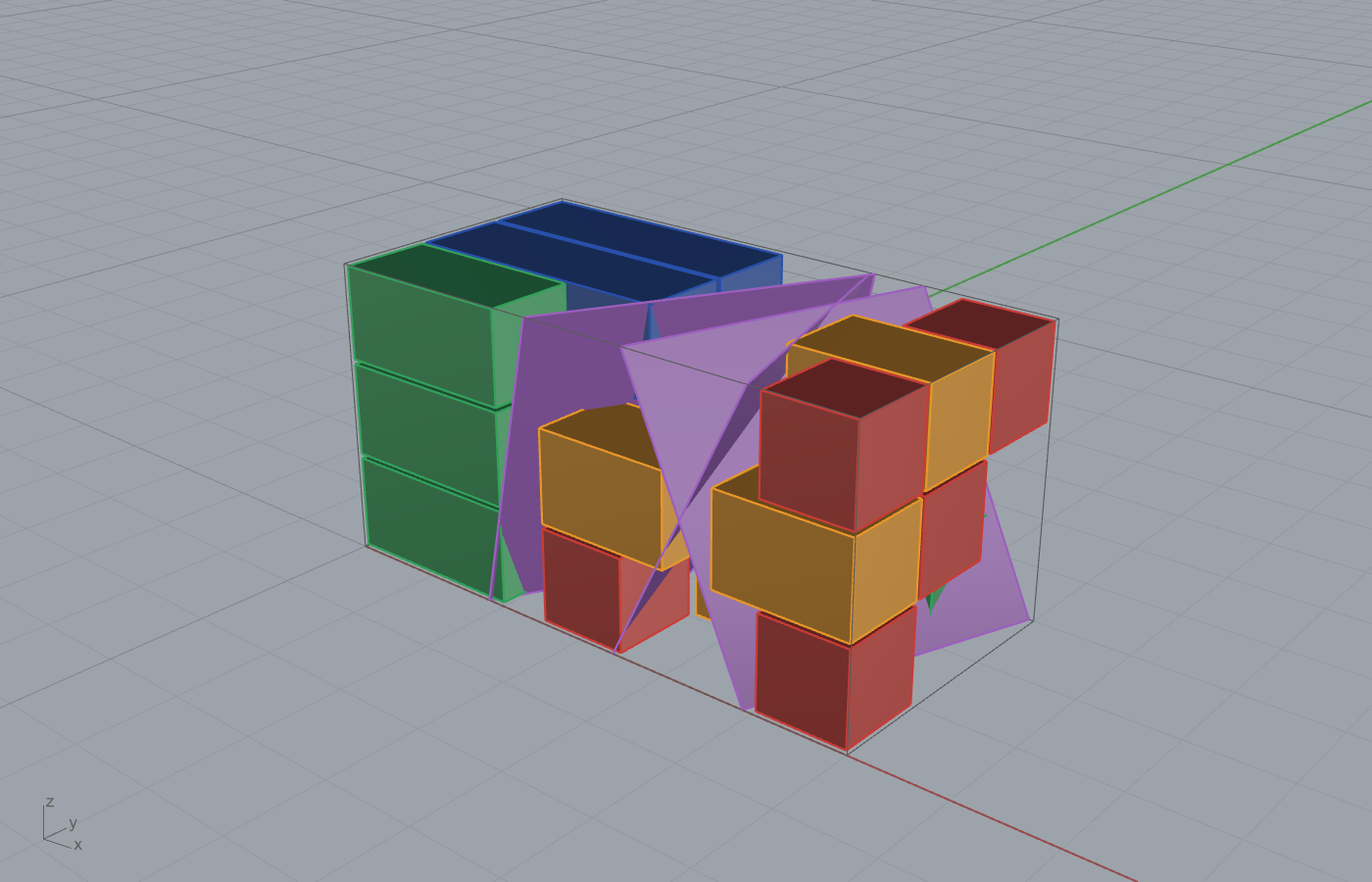
The economics are non-trivial: per the catalogue, price per \(m^3\) falls and cut
cost per \(m^3\) rises as blocks shrink, so the smallest 1x1x1 block has negative
net ($-200) (25_cost_metrics.json catalogue). The trade-off the example
quantifies: cost-to-balanced recovers +5.0 m3 for only -$1,000 net (-3.9%,
marginal \(200/m3), but cost-to-volume costs -\)8,950 (-34.9%) because reaching the
last cells forces premium gangsaw runs to be broken into loss-making offcuts. The
recommended operating point is balanced.
3.3 The bed-bounded hexahedra fix and flat-vs-oblique guillotine (example 08)
3.3.1 The bug
Example 08 packs real Botticino marble: a 600 MHz GPR grid yields 280 fracture
picks clustered into three dipping beds (0.72 m / 6.1 deg, 2.10 m / 0.9 deg,
3.70 m / 6.1 deg, sub-cm plane-fit RMS) (08_marble_cost_volume_metrics.json).
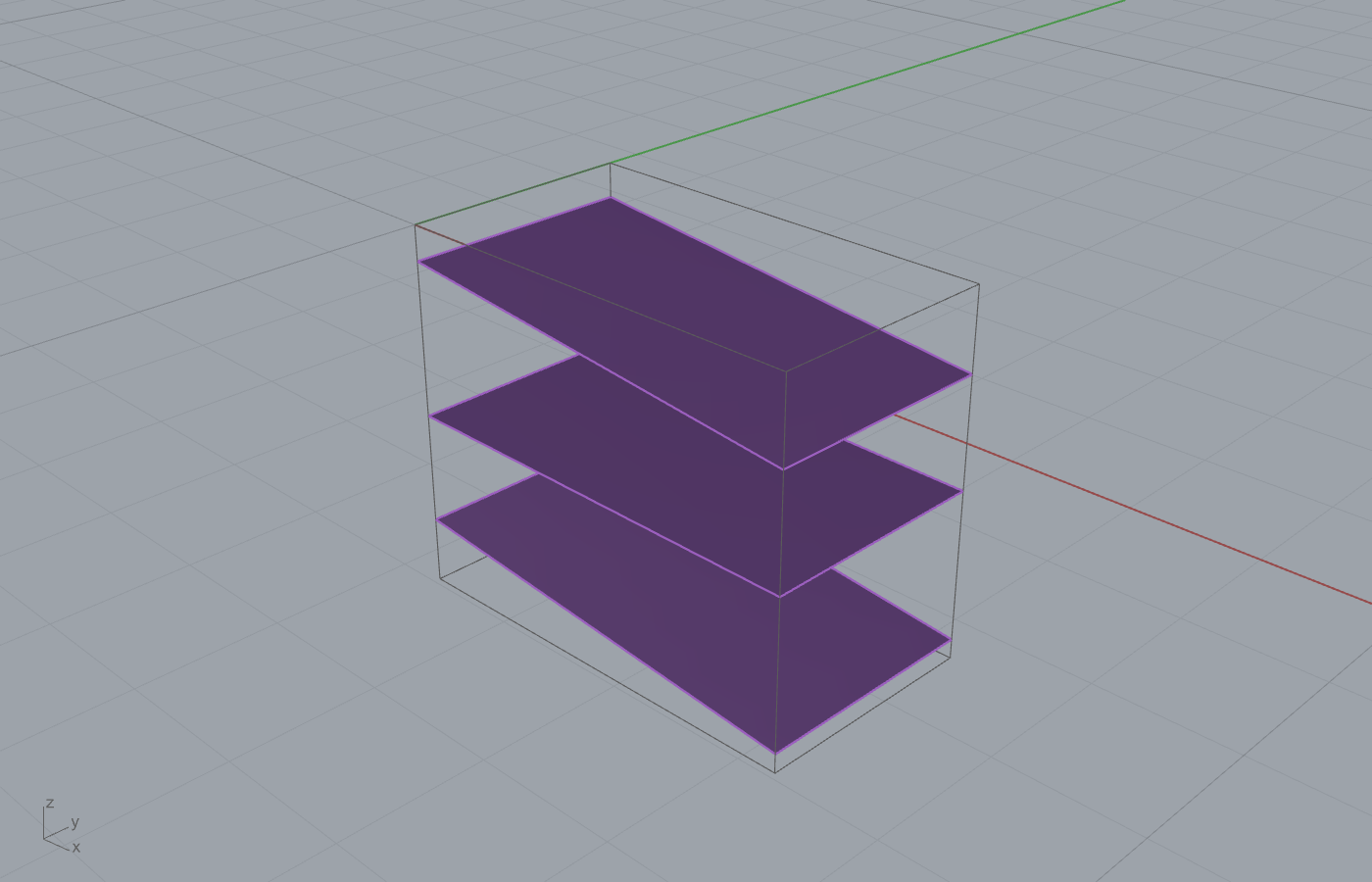
The original layout placed axis-aligned blocks at the mean bed depth. Because
the beds dip ~6 deg, a flat box centred at the mean depth crosses the dipping
bed plane at its ends, so the "intact" block actually straddles a parting. The
fix is to bound each block between the true bed planes rather than at a constant
\(z\): the recovered solids are bed-bounded hexahedra whose top and bottom faces
follow the per-\((x,y)\) bed planes. The metrics note records this directly:
"Block economics use each layer's mean spacing; the oblique geometry follows the
true per-(x,y) bed planes, so displayed blocks never cross a bed"
(08_marble_cost_volume_metrics.json, limitations). Concretely, a block with
footprint \([x_0,x_1]\times[y_0,y_1]\) between an upper bed plane
\(z_u(x,y)=a_u+b_u^x x+b_u^y y\) and a lower bed plane \(z_\ell(x,y)\) has its eight
corners on those two planes, so its local height varies across the footprint and
no corner pierces a parting.
3.3.2 Flat versus oblique guillotine
Two cut plans are compared. The flat plan places horizontal full-span cuts at the dip-safe envelope: the top cut at the deepest point of the upper bed, the bottom at the shallowest point of the lower bed, minus the keep-out. The wedges between the flat cut and the dipping bed are waste. This is fabricable on any gangsaw today. The oblique plan tilts each bed-parallel pass to follow the dipping bed, recovering the wedge.
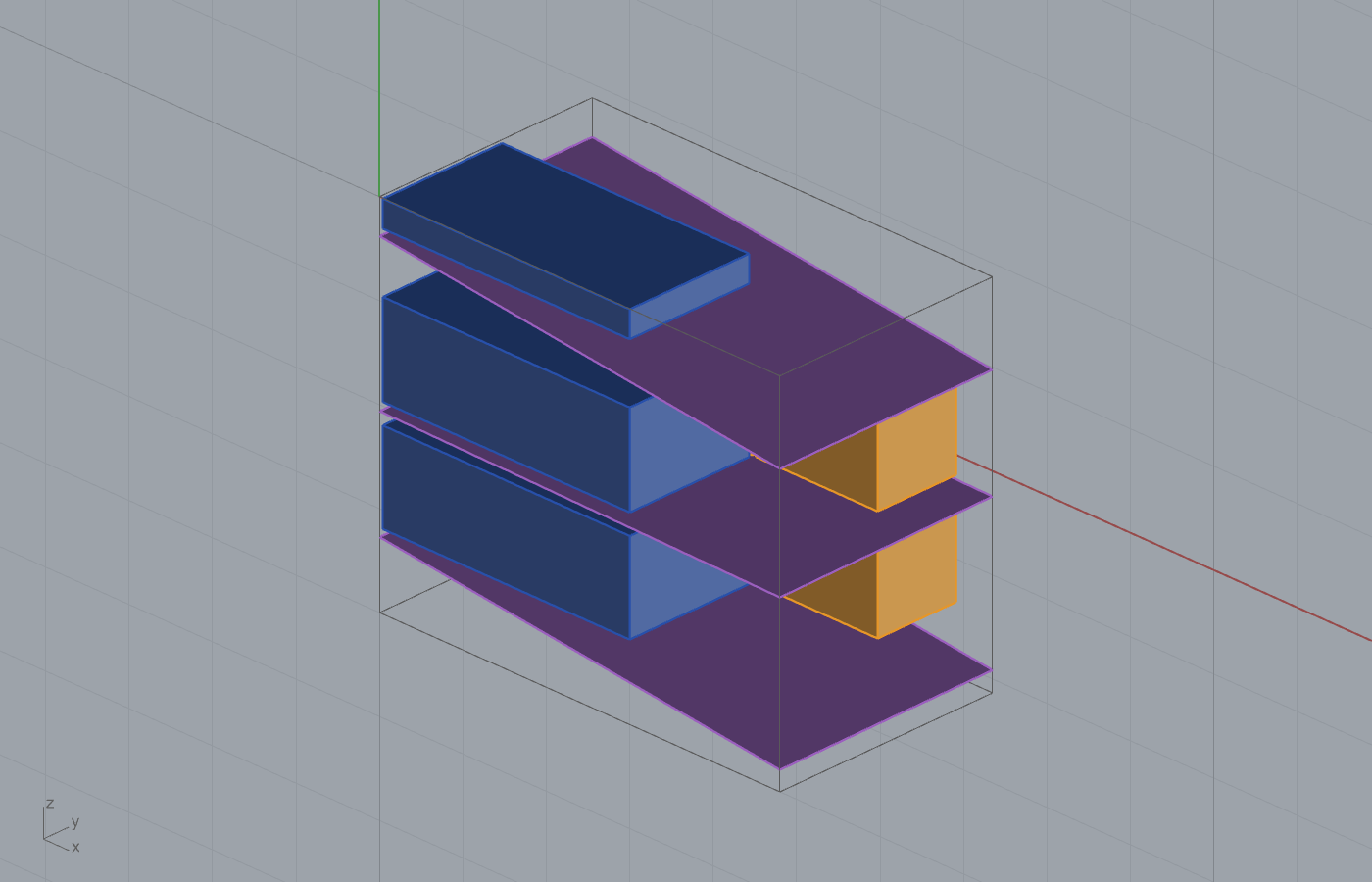
The dip-safe flat layer thicknesses collapse the nominal bed spacing
\([0.72,1.38,1.59,0.30]\) m down to \([0.328,1.051,1.037,0.161]\) m
(flat_guillotine.dip_safe_layers_m), losing the wedge volume. The measured
frontier (oblique vs flat, at max-cost):
| Plan | Volume | NET |
|---|---|---|
| Oblique (bed-following) | 32.16 m3 | $28,741 |
| Flat (orthogonal) | 20.26 m3 | $17,454 |
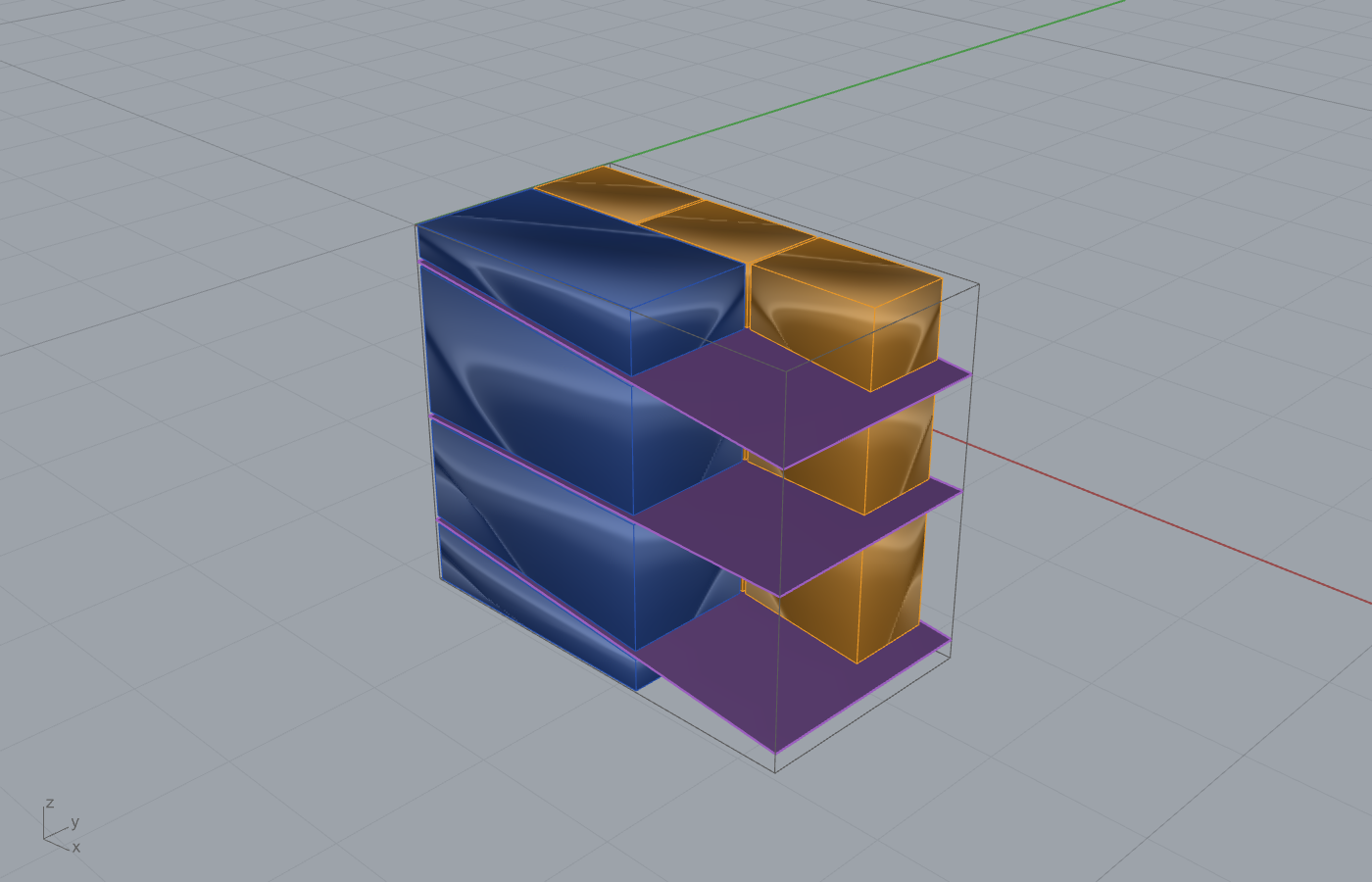
The georeferencing prize is the gap: oblique recovers +11.90 m3 (+59%) and
+$11,287 net per ~50 m3 bench, entirely because the beds dip ~6 deg. That delta is
the business case for the scanning + georeferenced-marking last mile required to
execute the sloped passes (georeferencing_prize_at_max_cost).
Originality. The bed-bounded hexahedra fix and the flat/oblique frontier are study-level constructions in the example generator, not a Core algorithm class; they are a facade-over-primitives result (bed-plane fitting plus the packing objective composed in the example). The recovery, cost, and frontier numbers are measured, not gated by a Core unit test, so they are REPORTED per the honesty convention. Tier B (engineering study on real data).
3.4 The guillotine cut sequence (example 24)
A gangsaw or bridge saw can only make straight edge-to-edge passes. Guillotine
packing guarantees every placed block is reachable by such cuts, so the plan is
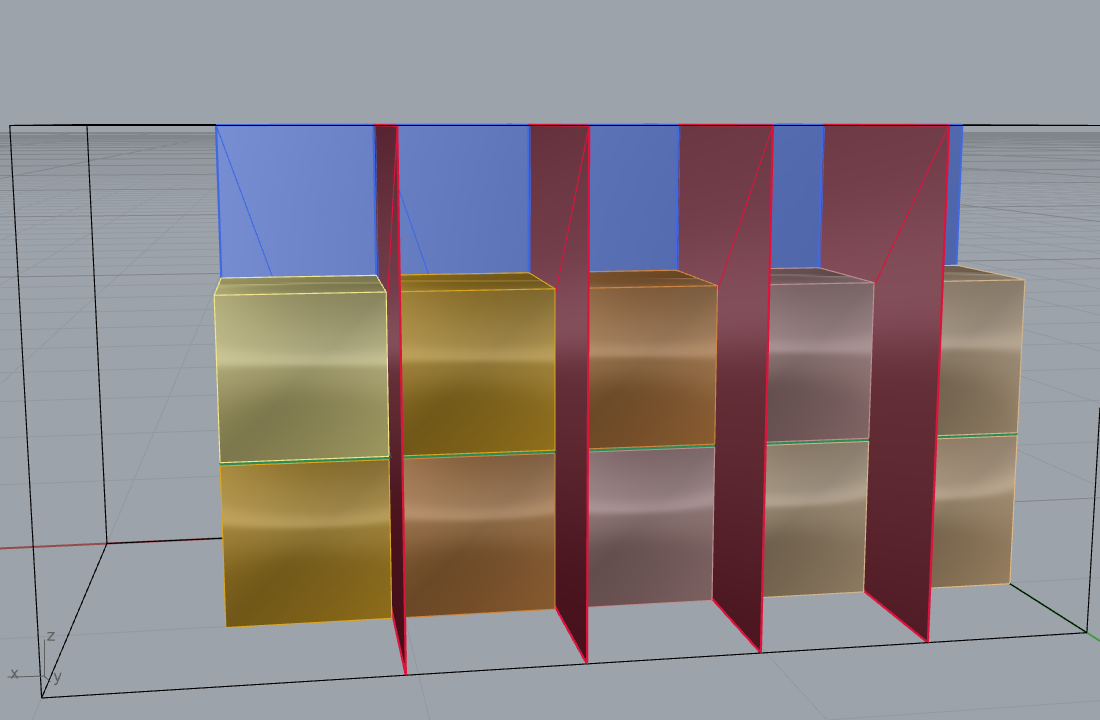
directly fabricable. Example 24 renders the literal saw passes that turn a
3.0 x 1.5 x 1.5 m quarry block into 20 dimension blocks of 0.5 m at 10 mm kerf
(grid \(5\times2\times2\)), in the real sequential order
(24_guillotine_metrics.json):
- RIP perpendicular to X \(\to\) 4 rip planes \(\to\) slabs.
- CROSS-Y per slab \(\to\) 5 planes \(\to\) columns.
- CROSS-Z per column \(\to\) 10 planes \(\to\) the 20 finished blocks.
That is 19 guillotine cuts for 20 blocks: each plane spans only its current sub-region, which is the defining property of a guillotine cut.
The same hierarchy resolves the balanced packing of example 25 into a saw plan:
two perp-Y cuts (3 slices), two perp-Z cuts (9 beams of 1 x 1 x 6 m), then 25
perp-X rip cuts within each beam, 29 passes total
(25_cost_metrics.json, guillotine_cuts_balanced). The oblique counterpart for
example 08 is 3 tilted bed-parallel passes plus 24 vertical rips, of which only
the 3 tilted passes need georeferenced marking
(oblique_guillotine_cut_plan_balanced).
Originality. Guillotine staging: facade-over-primitives / Tier C. It is standard staged guillotine cutting (Gilmore and Gomory 1965 lineage); the contribution is the rendered, in-order, fabricable saw plan on real geometry, not a new algorithm.
3.5 The recovery cascade (multi-scale reject-recover)
RecoveryCascade is the repository's named evolved-fork increment over single-
scale BlockCutOpt. At each scale (coarse \(\to\) fine) the solver runs on the tested
region; non-intersected blocks are recovered, and every block a fracture crosses
is fed back into the same engine at the next finer scale, cutting around the
fracture, until the remnant falls below the smallest marketable size
(RecoveryCascade.cs:9-37). The value recovered from a region \(R\) at scale \(s\)
obeys the recursion (RecoveryCascade.cs:26-29):
where kept/cracked partition the winning grid by the same SAT predicate
!bvh.AnyTriangleIntersects used in the single-scale solver
(RecoveryCascade.cs:91-119). The recursion depth is capped at the number of
scales (RecoveryCascade.cs:74), so it terminates. Crucially, with a single
ScaleSpec the cascade recovers exactly the blocks BlockCutOptSolver.Solve
finds at the same winning pose, so it is a faithful superset that reduces to
BlockCutOpt 2020 (RecoveryCascade.cs:21-24). This reject-coarse / recover-fine
structure is grounded in conditional two-scale cutting (Yarahmadi et al. 2018),
usable-leftover thresholds (Cherri et al. 2009), and staged guillotine cut-up
(Gilmore and Gomory 1965), with the unified 3D recursive form introduced in the
companion paper (RecoveryCascade.cs:31-36).
Originality.
RecoveryCascade: evolved-fork / A-candidate for the unified 3D recursive formulation. Licensing/honesty flag (E9): the header previously self-described "novel"; the audit ruling is to soften this with the BoEGE cite, which the current header does (Murugean 2026, DOI 10.5281/zenodo.20608279). The class is Core-validated (six headless tests per memory) but has no GH consumer; the shippedFractureBlockPackcomponent ships a self-contained recovery engine that calls none ofRecoveryCascade/BlockCutOptSolver/Dlbf3dMixedSizePacker(FractureBlockPackComponent.cs:9-25), a silent-disagreement risk whose resolution is facade-not-fork.
3.6 In-block secondary cutting (AMRR, I9/I12)
Improvement I9 couples the quarry-scale solver to in-block secondary cutting via
the Shao et al. (2022) AMRR (Average Material Removal Rate) plane-sequence
strategy (AmrrPlanner.cs:7-31). The planner iteratively cuts a blank convex
polyhedron by planes tangent to a target shape (a bounding sphere in v1): find the
vertex \(P_v\) farthest outside the target, cut by the plane through the tangent
point with normal from centre to \(P_v\), record the step, and repeat until the
outside volume falls below a convergence fraction (AmrrPlanner.cs:132-178). The
objective maximised is the average removal rate
removed volume over cutting time (AmrrPlanResult.Amrr, AmrrPlanner.cs:85),
where the per-cut path length feeding \(\tau_i\) comes from the Minetto et al.
(2017) shared-edge mesh section (improvement I12, SharedEdgeSlicer, used at
AmrrPlanner.cs:171-177). The GH front end is BlockCutOpt AMRR Plan
(GUID F2D0BC03-..., [Algorithm("AMRR in-block plane-sequence cutting",
"Shao, Liu, Gao 2022 ...")], BlockCutOptComponents.cs:215).
Originality.
AmrrPlanner: clean-room faithful implementation of Shao et al. (2022);SharedEdgeSlicerlikewise of Minetto et al. (2017). Tier B.
3.7 Saw-bed scheduling and extraction order (Quarry tab)
Two scheduling helpers round out the tab. The Saw Bed Schedule component
assigns recovered blocks to gangsaw beds by greedy LPT (Longest Processing Time)
list scheduling (Graham 1969, [Algorithm("Greedy LPT list scheduling",
"Graham 1969 ...", Doi 10.1137/0117039)],
QuarryCutOptComponents.cs:322). The Extraction Order Optimizer sorts blocks
by a weighted-sum greedy rule with a min-yield skip threshold; its [Algorithm]
attribute honestly records "Frahan-original ... no published scheduling algorithm
matched" (QuarryCutOptComponents.cs:223).
Originality. Saw Bed Schedule: clean-room Graham 1969, Tier C. Extraction Order: original-research / A-candidate (self-declared, prior-art sweep pending). Evidence as cited.
3.8 Heterogeneous facade
HeteroExt (Heterogeneous quarry extraction pipeline,
BlockCutOptHeterogeneousComponents.cs:169) is the correct facade pattern: it
composes BlockCutOptSolver plus the Chehrazad et al. (2025) Deepest-Left-Bottom-
Fill 3D mixed-size packer (improvement I7, [Algorithm("Deepest-Left-Bottom-Fill
(3D)", "Chehrazad, Roose, Wauters 2025 ...", Doi 10.1080/00207543.2025.2478434)],
BlockCutOptHeterogeneousComponents.cs:42). Per the HITL ruling its note credits
"interpretation and reimplementation of Elkarmoty 2020 and Chehrazad 2025 ... the
composition and the heterogeneity model are the contribution"
(BlockCutOptHeterogeneousComponents.cs:169).
Originality.
HeteroExt: facade-over-primitives. Tier D for the wrapper; the wrapped DLBF is clean-room Chehrazad 2025 (Tier B).
3.9 Status and what's left
- RBE-style correctness is out of scope here but the same audit gates the
quarry tab's honesty conventions. No
BlockCutOptsign-bug is present; the parallel argmax is bit-identical to serial (validated). RecoveryCascadehas no GH consumer (blocker for shipping the cascade on canvas).FractureBlockPackduplicates a recovery engine instead of calling the validated Core cascade; resolution is facade-not-fork.- Coarse-to-fine in the Omni solver is a stub bridge.
UseCoarseToFinecurrently runs the uniform-grid Pareto sweep at the fine step on both branches (BlockCutOptOmniSolver.cs:150-169), the worst-case wall clock; the true coarse-to-fine Pareto sweep is a follow-up. - Kerf volume is a film approximation (\(A_{xy}k/2\),
BlockCutOptSolver.cs:261-268), refined alongside sub-division but not exact. - Two improvements unshipped: I13 (multi-model joint generator, Tian 2025) is
proposed only; I14 (composite multi-convex block, Zhang et al. 2024) is partial
(
README.md:197-200). - Bed-bounded hexahedra and the flat/oblique frontier are example-level, not a Core class; numbers are REPORTED (measured), not gated by a unit test.
- Data licence: example 08 marble GPR data is CC-BY-NC-ND (research/testing
only, not commercial product demos) (
08_marble_cost_volume_metrics.json).
References (this chapter)
Akenine-Moller, T. (2001). Fast 3D Triangle-Box Overlap Testing. Journal of Graphics Tools 6(1):29-33.
Cherri, A.C., Arenales, M.N., Yanasse, H.H. (2009). The one-dimensional cutting stock problem with usable leftover. European Journal of Operational Research 196(3):897-908. DOI 10.1016/j.ejor.2008.04.039.
Chehrazad, R., Roose, D., Wauters, T. (2025). A fast and scalable deepest-left-bottom-fill algorithm. International Journal of Production Research 63:6606-6629. DOI 10.1080/00207543.2025.2478434.
Elkarmoty, M., Bondua, S., Bruno, R. (2020). A 3D brute-force algorithm for the optimum cutting pattern of dimension stone quarries. Resources Policy 68:101761. DOI 10.1016/j.resourpol.2020.101761.
Gilmore, P.C., Gomory, R.E. (1965). Multistage cutting stock problems of two and more dimensions. Operations Research 13(1):94-120. DOI 10.1287/opre.13.1.94.
Goodman, R.E., Shi, G.-h. (1985). Block Theory and Its Application to Rock Engineering. Prentice-Hall.
Graham, R.L. (1969). Bounds on multiprocessing timing anomalies. SIAM Journal on Applied Mathematics 17(2):416-429. DOI 10.1137/0117039.
Jalalian, M., Bagherpour, R., Khoshouei, M. (2023). Environmentally sustainable mining in quarries to reduce waste production and loss of resources using the developed optimization algorithm. Scientific Reports 13. DOI 10.1038/s41598-023-49633-w.
Minetto, R., Volpato, N., Stolfi, J., Gregori, R.M.M.H., da Silva, M.V.G. (2017). An optimal algorithm for 3D triangle mesh slicing. Computer-Aided Design 92:1-10. DOI 10.1016/j.cad.2017.07.001.
Murugean, L. (2026). GPR-to-block-yield optimization for fractured dimension-stone quarries (submitted, Bulletin of Engineering Geology and the Environment; reproducibility deposit). DOI 10.5281/zenodo.20608279.
Shao, H., Liu, Q., Gao, Z. (2022). Material Removal Optimization Strategy of 3D Block Cutting Based on Geometric Computation Method. Processes 10(4):695. DOI 10.3390/pr10040695.
Yarahmadi, R., Bagherpour, R., Sousa, L.M.O. (2018). Discontinuity modelling and rock block geometry identification to optimize production in dimension stone quarries. Engineering Geology 232:22-33. DOI 10.1016/j.enggeo.2017.11.006.
Zhang, N., Zheng, H., Yang, M., Wang, N. (2024). An open-source MATLAB toolbox for 3D block cutting and 3D mesh cutting in geotechnical engineering. Advances in Engineering Software 197:103762. DOI 10.1016/j.advengsoft.2024.103762.