01. Two-Dimensional Nesting & Trencadís¶
This chapter covers the repository's two-dimensional geometry-packing
subsystem: the 2D Packing ribbon tab (13 components) and the Trencadis
ribbon tab (5 components). The shared engine is exact No-Fit-Polygon
Bottom-Left-Fill on a Clipper2 integer-snapped back end. Three nesters are in
scope: the shipped IrregularSheetFillV506 (FreeNest), its exact-NFP sibling
IrregularSheetFillNfpBlf (FreeNestX), and the hole-aware
ContactNfpHoleNester / CNH (HoleNest). The Trencadís family adds a
centroidal-Voronoi cell partition plus optimal one-to-one shard assignment.
The mathematics here is real plane geometry: Minkowski sums, the no-fit and
inner-fit polygons, and a distance-based penetration certificate. Where the
repository evolved the published math we show the derivation, not only the
final formula. Every originality claim is anchored to a file:line, an
[Algorithm] attribute, or a measured benchmark.
The packing-quality metric used throughout is stock utilisation
placed part material area over net sheet area (sheet minus its holes). It is
computed by boolean area, not bounding boxes, and it is reported, not
gated in the components; the gate is the zero-overlap validity certificate
of section 1.6. (Definition: examples/10_pack2d/README.md.)
1. The No-Fit-Polygon nesting core¶
1.1 The no-fit polygon (NFP)¶
Let two polygons \(A\) and \(B\) be given with \(A\) fixed and \(B\) free to translate by \(t\in\mathbb{R}^2\). Write \(B(t)=\{b+t : b\in B\}\). The no-fit polygon is the set of translations for which the interiors of \(A\) and \(B\) overlap:
The standard result (Bennell and Oliveira 2009) is that this set is exactly a Minkowski sum of \(A\) with the point-reflection of \(B\):
Derivation. The interiors meet iff there exist \(a\in A\), \(b\in B\) with
\(a=b+t\), i.e. \(t=a-b=a+(-b)\). The set of all such \(t\) is exactly
\(\{a+(-b)\}=A\oplus(-B)\). Placing \(B\) at any \(t\) on the boundary of this set
makes \(A\) and \(B\) touch without interior overlap; any \(t\) outside the set is
collision-free. This is the geometric primitive every component in this
chapter uses for collision. In code the reflection is Reflect and the sum is
Clipper2Adapter.MinkowskiSum
(ContactNfpHoleNester.cs:1484, :962; the engine contract is documented at
ContactNfpHoleNester.cs:28-31).
1.2 The inner-fit polygon (IFP)¶
The container constraint is the dual. The inner-fit polygon is the set of translations that keep \(B\) inside a container \(C\):
For a convex container this is an erosion (Minkowski difference) \(C\ominus B\). The repository realises it as an exact intersection over the vertices of the convex hull of \(B\):
Derivation. \(B(t)\subseteq C\) holds iff every vertex \(b_i+t\in C\). Because
\(C\) is intersected against the convex hull of \(B\), containing the hull
vertices is sufficient to contain all of \(B\) (a convex combination of points
in a convex set stays in the set). Each constraint \(b_i+t\in C\) rearranges to
\(t\in C-b_i\), and the feasible \(t\) is the intersection over all hull vertices.
This is exact for a convex \(C\) and conservative (never admits an
out-of-bounds placement) for a concave \(C\) (ContactNfpHoleNester.cs:1332-1352;
hull by Andrew's monotone chain, :1355-1368). The hull pass is the
cost saver: it replaces a full-resolution erosion with at most
\(|\operatorname{hull}(B)|\) Clipper intersections.
1.3 The feasible region and Bottom-Left-Fill¶
Combining the two, the set of legal placements of part \(B\) at a fixed rotation, given a sheet \(S\) with holes \(\{H_l\}\) and already-placed parts \(\{A_k\}\), is
This is stated verbatim in the engine header
(IrregularSheetFillNfpBlf.cs:18-27) and in the CNH header
(ContactNfpHoleNester.cs:30-31). Non-overlap is therefore a hard
constraint of construction, not a post-hoc trim.
The Bottom-Left-Fill placement rule (Burke et al. 2006) selects, among all feasible translations, the one that is lowest, then leftmost:
The optimum of a linear lexicographic objective over a polygonal region lies at
a vertex of that region, so the search reduces to scanning the
feasible-region vertices in \((y,x)\) order and taking the first that survives
verification (ContactNfpHoleNester.cs:980-1002,
OrderedVertices :1625-1634; IrregularSheetFillNfpBlf.cs:314-315).
Originality. The NFP-BLF nesting family is clean-room. The published mathematics is cited in source by
[Algorithm]attributes: Bottom-Left-Fill to Burke, Hellier, Kendall, Whitwell (2006), Operations Research 54(3):587-601, DOI10.1287/opre.1060.0293; NFP/IFP via Minkowski sum to Bennell and Oliveira (2009), JORS 60(S1):S93-S105, DOI10.1057/jors.2008.169; the boolean back end is the vendored Clipper2 (Johnson, BSL-1.0) with no copyleft (evidence:IrregularSheetFillNfpBlfComponent.cs:24-32,HoleNestComponent.cs:25-33). No upstream nesting source sits in the tree. Tier B (faithful implementation of published work), with the V506 to NFP-BLF delta and the CNH increments below carrying the research weight.
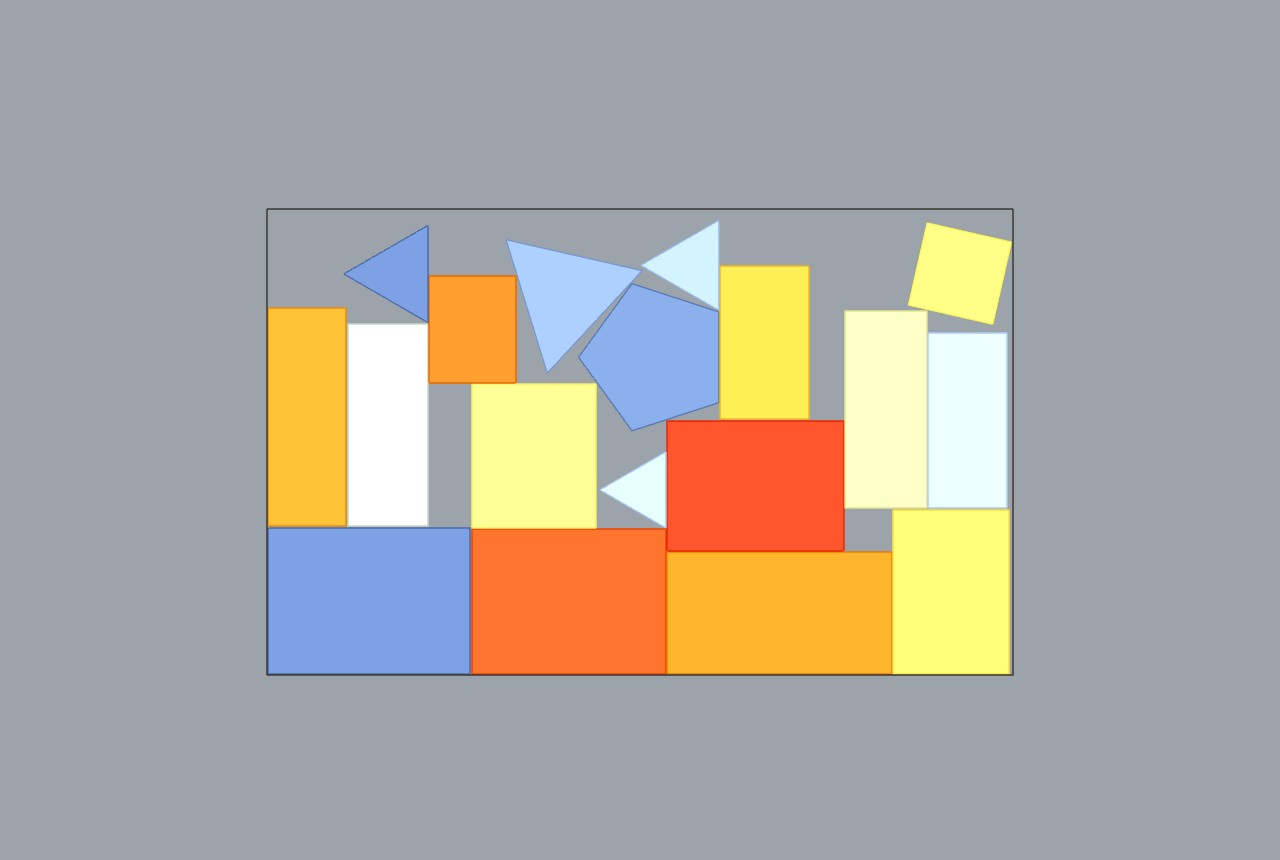
1.4 V506 to NFP-BLF: the measured delta¶
The originally shipped nester is IrregularSheetFillV506 (FreeNest, GUID
D5E7A2B1-8C34-4F1E-A096-3B7F5D2E8A4C). It is an NFP-assisted bottom-left
placement that, by design, permits a bounded overlap controlled by a
Trim Tolerance and then boolean-trims the contact. With the default
Trim Tolerance of 0.1 it produces apparent overlaps; this is the documented
behaviour, not a fault (KB-6/KB-7; examples/10_pack2d/README.md).
IrregularSheetFillNfpBlf (FreeNestX, GUID
2d351646-2cb0-402a-bbd8-3950b5bb1fbc) re-derives the placement so that the
feasible region is the complete IFP-minus-NFP set, making zero overlap a
hard constraint. The measured improvement is recorded in source: a mean wasted
area cut of 53.9% against V506 at zero overlap, validated against a Python
reference (IrregularSheetFillNfpBlf.cs:21-22). FreeNestX is the only
zero-overlap packer in the study to cross the 80% utilisation bar with holes:
82.0% oversub, 84.7% on the L-plus-hole fixture, 89.6% on a hard 3-hole
fixture (examples/10_pack2d/README.md). The four legacy V1/V2/V3/V506
wrappers are marked [Obsolete] and Exposure=hidden per the 2D-V-solver
phase-out (Pack2DIrregularSheetV506Component.cs:56-57).
Originality. FreeNestX is an evolved-fork of V506: same NFP/BLF lineage, but a re-derived complete feasible region replaces the overlap-then-trim contract, with the 53.9% waste-cut measured delta (
IrregularSheetFillNfpBlf.cs:18-27, commit lineage atoutputs/2026-06-03/pack2d_nfp_evolution).
1.5 The Unified dispatcher¶
IrregularSheetFillComponent (FreeNestU, GUID
AB12C00B-1A2B-4C3D-9E4F-5A6B7C8D9E0B) is a strategy selector that dispatches
to the V1/V2/V3/V506 variants behind one canvas box. It adds no new algorithm;
every internal step resolves to an in-repo nesting variant.
Originality. facade-over-primitives (variant dispatcher), with the
[Algorithm]note explicitly calling it a "Frahan-original strategy selector" over Burke 2007 and Bennell and Oliveira 2008 (IrregularSheetFillComponent.cs:32-33,:42).
1.6 The hole-aware nester (CNH / ContactNfpHoleNester)¶
The ContactNfpHoleNester (HoleNest component, GUID
D5F10019-8A3C-4D17-B5E2-6C90F2A47D31) evolves FreeNestX with two capabilities
it lacks, both validated in outputs/2026-06-12/hole_packer_evolution
(ContactNfpHoleNester.cs:10-33).
1.6.1 Contact-adaptive rotations¶
A fixed rotation list cannot seat a part flush against a wall, a neighbour, or a hole edge. CNH augments the uniform base set \(\{0,\tfrac{\pi}{2},\pi,\tfrac{3\pi}{2}\}\) with edge-alignment angles. For a host edge with direction angle \(\alpha_h\) and a part edge with direction angle \(\alpha_p\), the rotation that makes the part edge parallel to the host edge is
evaluated over the longest edges of the part against the longest edges of the
sheet and the most recently placed neighbour (ContactNfpHoleNester.cs:1304-1330,
RotationSet :1281-1302). The total angle budget is bounded by
\(\max(4,\ \mathrm{base}+4+2\,\mathrm{contact})\), and symmetric rotations are
collapsed by a translation-invariant shape signature (RotSignature,
:1917-1929) so each distinct rotated shape evaluates its NFP once.
1.6.2 Part-in-part-hole nesting (holes-first)¶
A small part can be nested inside the hole of a larger placed part. The
hole acts as a container, so the legal translations of filler \(B\) into host
hole \(G\) are exactly the inner-fit region \(\mathrm{IFP}(B,G)\) of section 1.2.
The schedule is holes-first: parts that have holes are placed as hosts (area
descending), the smallest remaining parts are nested into the open host holes,
then the remaining outers are placed by NFP-BLF
(ContactNfpHoleNester.cs:528-592). This is the GPR-defect-as-sheet-hole
differentiator for stone: pack saw-cuttable parts only in intact rock,
nesting offcuts into the voids of larger remnants
(outputs/2026-06-12/hole_packer_evolution/HOLE_PACKER_MATH_AND_BENCHMARK.md,
section 4).
1.6.3 The penetration-depth certificate (original derivation)¶
The NFP and IFP are built on simplified inputs: a Ramer-Douglas-Peucker pass
with tolerance \(\tau=2\times10^{-3}\,\mathrm{diag}(p)\) carves the no-fit
region slightly inward (NfpSimplifyTol, :1619-1623), and the hull-based IFP
is anti-conservative on concave sheets. Area-relative gates alone admit
needle overlaps: a tiny intersection area (order \(10^{-5}\) of part area)
but a penetration depth up to roughly 0.2 caller units. The repository's answer
is a compound gate on the true, unsimplified geometry; the NFP/IFP are
treated as pruning devices only (ContactNfpHoleNester.cs:35-72).
For loops \(A\) and \(B\), penetration depth is the maximum distance any probe of one loop that lies strictly inside the other travels to that other loop's boundary, augmented by an edge-crossing term:
where the probe set \(\Pi(\cdot)\) is the loop's vertices, edge midpoints, and
area centroid (the centroid closes the full-containment blind spot), and
\(d_{\times}\) is the maximum proper edge-crossing perpendicular depth
(PenetrationDepth :1777-1798, DepthProbes :1822-1839,
MaxProperCross :1879-1908). Containment uses the analogous
OutsideDepth.
A candidate is accepted only if its depth stays under a scale-relative tolerance instantiating the project epsilon budget at the verification level:
with \(\mathrm{SnapGrid}=0.01\) scaled units \(=10^{-5}\) caller units at the
internal scale \(1000\) (DepthTolFor :1646-1647, constants :1640-1643).
Engine math runs in scaled space because Clipper snaps to a fixed decimal
precision; small-unit (metre) geometry would otherwise build sliver-noisy NFPs
(Pack conditioning :121-154).
The micro-retreat. Rather than discard a contact-tight candidate that only violates through NFP simplification, the gate nudges it once along the measured penetration vector \(\mathbf{p}=(p_x,p_y)\) (length \(=d\)) by \(d+\mathrm{SnapGrid}\) and re-verifies:
If the nudged placement passes, it is accepted; otherwise the candidate is
rejected (TryVerifiedCandidate :1728-1748). This keeps the layout from
starving while never accepting a deeper-than-floor penetration. The same
compound gate runs path-independently in Validate (:1373-1449), so
Valid==true certifies the layout on every engine path, including the
fast path below.
1.6.4 The rect shelf fast-path¶
When every loop in the instance is an axis-aligned rectangle, the NFP and IFP
degenerate to rectangles and the whole solve reduces to interval arithmetic
with no Clipper calls. Rotations collapse to \(\{0,\tfrac{\pi}{2}\}\) (squares to
\(\{0\}\)) using the exact integer map \((x,y)\mapsto(-y,x)\) so there is no
trigonometric round-off (TryRectFastPath :635-738, detection :742-767,
exact transform :883-895). A completeness fallback guards it: if the
sparser shelf candidate set strands any part (about 1 in 4000 in fuzzing), the
fast-path result is discarded and the general engine runs, so speed never
trades away a placement (Pack :173-189).
1.6.5 Multi-start keep-best¶
The general engine optionally runs \(K\) deterministic part orders (area,
max-dimension, width, height; all descending) and keeps the densest valid
layout, breaking ties by placed count, then density, then smallest used
bounding-box diagonal (BuildOrder :424-438, keep-best :243-292). The
ordering keys form a total permutation, so the winner is reproducible.
Determinism is enforced at the cache level: each pass allocates its own
NFP cache keyed on (obstacle index, rotation signature), and the index is into
the per-pass placement order, so a cache shared across passes would return the
wrong NFP. The header documents this as the critical correctness point
(ContactNfpHoleNester.cs:199-210). \(K=1\) reproduces the original single pass
byte-for-byte; FRAHAN_MULTISTART=0 is the kill switch.
1.6.6 Deviation-compensated spacing (original derivation)¶
The solver collides on sampled proxies of smooth curves, but the output is
the exact original curve. A chord cuts inside the true curve by the sampling
sagitta, so two proxies that merely touch can let the true full-resolution
curves cross by up to that deviation on each side. The Grasshopper wrapper
measures the worst proxy deviation (max distance from a chord midpoint back to
the true curve) and inflates the engine spacing to compensate
(HoleNestComponent.cs:758-790, :532-542):
Derivation of the asymmetric coefficients. A part-to-part clearance must
absorb the deviation of both colliding part proxies, hence \(2\delta_{\text{part}}\).
A part-to-sheet clearance absorbs the part deviation through the same term, but
the sheet term enters once: a part can poke past the true boundary by at
most the sheet proxy's own deviation, and the sheet samples at high resolution
(192 verts) so \(\delta_{\text{sheet}}\) stays tiny. The earlier shared formula
used \(2\,\max_{\text{all loops}}\delta\), which let a large freeform sheet's
deviation inflate every part (a reported +27 units on the user's S-sheet,
collapsing a fill from 200 to 21); the asymmetric split is the fix
(HoleNestComponent.cs:45-48, :532-542). The compensation is surfaced to the
user as ProxyDevComp: +{2*maxDev} in the report (:653).
Originality. CNH is clean-room at its NFP/BLF/IFP base (same citations as FreeNestX,
HoleNestComponent.cs:25-33) with three evolved-fork increments that carry the research weight, each measured or fuzz-verified: the contact-adaptive rotation set, the part-in-part-hole IFP nesting, and the distance-based penetration certificate with micro-retreat. The[Algorithm]attribute names these as "Frahan ContactNfpHoleNester evolution study" and the head-to-head protocol is documented, not asserted (HoleNestComponent.cs:34-36). The component is the CNH facade over the Core engine. The native batched-NFP path wrapsnfp_kernel.dll, which vendors official Clipper2 (BSL-1.0) unmodified (NativeNfpKernel.cs:10-22); that is vendored-library, with only the marshalling ours.
1.6.7 Head-to-head: V506 vs NFP-BLF vs CNH vs the reference physics nester¶
The 2026-06-12 hole-packer study benchmarked CNH against the OpenNest-lineage
reference physics nester (the jagua-rs guided-local-search strip packer,
"Sparrow") and an MIT-licensed C++ NFP-GLS native nester
(HOLE_PACKER_MATH_AND_BENCHMARK.md). On the true-hole lane (1 sheet, 1
sheet-hole, 4 host parts with slanted holes, 8 fillers):
| Packer | time | placed | holes filled | valid | deterministic |
|---|---|---|---|---|---|
| CNH v1 (general exact-NFP) | 60.7 ms | 12/12 | 4 | true | yes |
| CNH v2 (rect fast-path) | 0.148 ms | 12/12 | 4 | true | yes |
| MIT native nester (shelf) | 21.6 ms | 12/12 | 4 | true | no (stochastic) |
| Reference physics nester (Sparrow) | 3255 ms | 12/12 outlines | 0 | false | no |
CNH is valid where the reference physics nester is invalid: Sparrow ignores
holes (4 hole-ignore warnings, 953.7 overlap loss) and produces no usable
hole-aware layout at any time budget. Against Sparrow, CNH v1 is about
54x faster and valid on the same parts (60.7 ms vs Sparrow's invalid 3255 ms);
the rect fast-path is 0.148 ms, about 22,000x the invalid Sparrow time. Against the
strongest valid baseline (the native shelf) CNH v1 is 2.8x slower because it runs
the general exact-NFP construction rather than an axis-aligned shortcut; its v2 rect
fast-path runs in 0.148 ms on the true-hole bench, 146x the native shelf's 21.6 ms on
that same instance (an axis-aligned shortcut, not a separate all-rectangle benchmark),
and it is the only deterministic engine.
The honesty boundary is held in source: on the outline-only strip lane the
reference physics nester still wins density by 6 to 10 percent, and no
universal "2x better" claim is made there
(../../benchmarks/HOLE_PACKER_MATH_AND_BENCHMARK.md, sections 2-3).
2. Trencadís mosaics¶
Trencadís is the Gaudí "broken-tile" technique: irregular shards placed close
together with a grout gap. The repository ships two distinct solver
philosophies under the Trencadis tab, plus an EdgeMatch variant.
2.1 Catalog mode: CVD-Lloyd cells + Hungarian assignment¶
Pack2DTrencadisCatalogComponent (TrencadisCat, GUID
F2D00007-CADC-4F2D-9007-7E60CADA15A0) is the example-12 engine. It partitions
the sheet into blue-noise cells then assigns shards to cells one-to-one.
Centroidal Voronoi cells (Lloyd 1982). A Voronoi diagram of \(K\) seeds is centroidal when each seed coincides with the centroid of its own cell. Lloyd's algorithm reaches this fixed point by iterated relaxation: assign each domain point to its nearest seed, then move each seed to the centroid of its cell:
The repository discretises the domain (outer polygon minus holes) on an
\(N\times N\) grid with uniform density \(\rho\equiv 1\), assigns each grid cell to
its nearest seed, recentres, and stops when the largest seed move drops below
half a grid step (CvdLloyd2d.cs:30-108). The result is a blue-noise seed
field, far better than placing the first piece at a bbox corner.
Optimal assignment (Kuhn-Munkres). With \(n\) shards and \(n\) cells, let the cost \(c_{ij}\) be the area mismatch of placing shard \(i\) in cell \(j\). The minimising one-to-one assignment solves
via the \(O(n^3)\) shortest-augmenting-path Hungarian method, with row and
column potentials \(u_i,v_j\) maintained so reduced costs
\(c_{ij}-u_i-v_j\ge 0\) stay non-negative (HungarianAssignment.cs:23-85). Each
placed shard is moved to its cell centroid and inset by the grout offset to
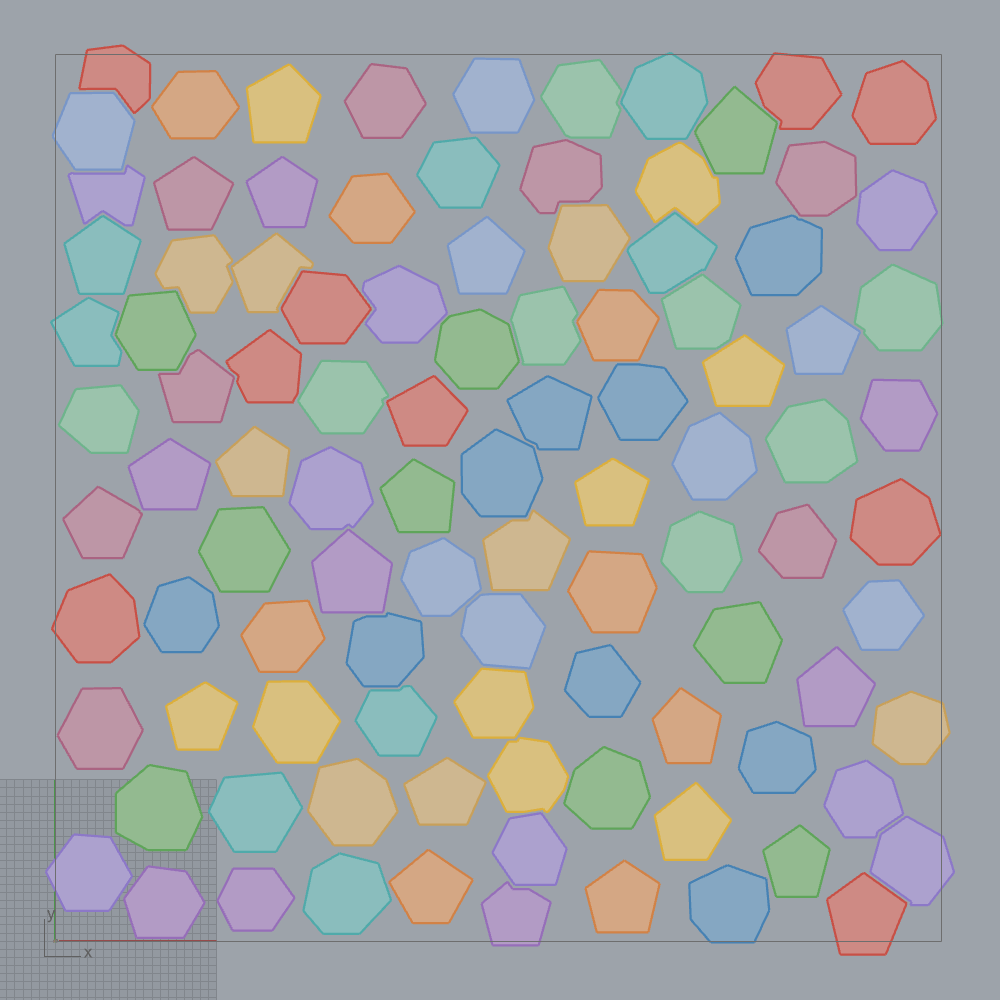
leave the mortar gap. Example 12 places 28 shards into 28 cells in 53 ms with
zero warnings (examples/12_trencadis/README.md).
Originality. CVD-Lloyd is clean-room from Lloyd (1982) centroidal Voronoi relaxation (
CvdLloyd2d.cs:14-22,[Algorithm]atPack2DTrencadisCatalogComponent.cs:37). The Hungarian solver is a clean-room textbook Kuhn-Munkres / Bourgeois-Lassalle (1971) shortest-augmenting-path implementation, allocation-bounded and net48-compatible (HungarianAssignment.cs:11-15). The catalog placement wrapper that couples them is facade-over-primitives: its[Algorithm]credits "Slab-partitioned Voronoi catalog; Frahan-original Trencadis extension" over a Battiato 2013 synthesis precedent (Pack2DTrencadisCatalogComponent.cs:38,:42). Tier C/B.
2.2 Physics-settle variants vs the greedy/EdgeMatch variants¶
The Trencadis tab is intentionally not one engine. The variants differ in
how a piece reaches its final pose, and the repository keeps them separate
rather than blind-merging them (the "the 2D solvers are real, validate don't
merge" ruling):
- Greedy NFP-slide (
Pack2DTrencadisComponent, GUIDF2D00002-...). Pieces slide along a Minkowski-difference arc-length sampler until they butt against placed neighbours, with a bounded-overlap trim up to the Trim Tolerance and the Battiato 2013 §4 cumulative-cut budget (\(T_N\) for the new piece, \(T_P\) for placed) (TrencadisFill.cs:13-27,Pack2DTrencadisComponent.cs:37-38). The standalone greedy box is a skeleton returning empty; the working entrypoint is the catalog or pipeline component (examples/12_trencadis/README.md). - Dynamic settle (
Pack2DTrencadisDynamicComponent, GUIDF2D00008-...). After a greedy pack, a Kangaroo 2 goal-based dynamic relaxation pass settles the pieces to fill residual gaps (physics, not geometry). Headless coverage 55.1% with physics on vs 52.7% greedy (Pack2DTrencadisDynamicComponent.cs:61-62,examples/12_trencadis/README.md). - EdgeMatch (
TrencadisEdgeMatchComponent, GUIDF2D0000A-...). Drives placement through the 5-stage EdgeMatch pipeline plus a deterministic beam-search assembly solver, an alternative to the Battiato 2013 CVD+GVF stack (TrencadisEdgeMatchComponent.cs:28-29). - Pipeline (
Pack2DTrencadisPipelineComponent, GUIDF2D00009-...) composes greedy pack + NFP slide + CVD-Lloyd seeding + an optional Kangaroo 2 settle (Pack2DTrencadisPipelineComponent.cs:59-62).
Originality. The greedy NFP-slide and the dynamic/EdgeMatch/pipeline wrappers are facade-over-primitives that compose published Frahan primitives (CVD-Lloyd, NFP slide, Hungarian, EdgeMatch, the Kangaroo 2 relaxation). The physics step explicitly credits Daniel Piker's Kangaroo 2 (
Pack2DTrencadisDynamicComponent.cs:62); the Trencadís domain framing is credited to Gaudí Park Güell and the Battiato 2013 synthesis. None claims a new algorithm; the contribution is the integration. Tier C/D.
3. Status & what's left¶
- Example 28 (hole nest) has no rendered figure. The folder ships the
.ghdemo only (examples/28_hole_nest/), no PNG and no README. The CNH renders in this chapter borrow from example 10 (nesting) and example 12 (Trencadís). Severity: low (documentation gap, not a code gap). - Deployed
.ghalag (KB-7). The example-10 validity figures are from the headless harness on current source. An older deployed.ghamay still overlap parts on a live 2D solve; rebuild and redeploy before trusting a live result (examples/10_pack2d/README.md). Severity: medium. - Standalone greedy Trencadís box returns empty.
Frahan Trencadís Packis a skeleton; the working entrypoints are the Catalog and Pipeline components (examples/12_trencadis/README.md). Severity: medium (a ghost on the ribbon, against AGENTS.md section 6). - Rect fast-path spacing limitation. The exact rectangle shelf path only
activates at
spacing == 0; spacing > 0 needs exact rect-dilation bookkeeping and is deferred to the general engine (ContactNfpHoleNester.cs:611-616). Severity: low (correct fallback exists). - Residual penetration band. After the compound gate, penetrations inside
the snap band (about \(2\times10^{-5}\) caller units) can be accepted; deeper
ones cannot on any path. This is a stated, bounded residual, far inside any
fabrication budget (
ContactNfpHoleNester.cs:69-72). Severity: low. - Outline-density gap to the reference physics nester. On the no-hole
outline strip lane the reference physics nester (Sparrow) still wins density
by 6 to 10 percent; CNH's claimed win is the hole-aware lane only. This
boundary must stay in any external claim
(
HOLE_PACKER_MATH_AND_BENCHMARK.md, section 2c). Severity: low (honesty, not a defect).
References (this chapter)¶
- Burke, E.K., Hellier, R., Kendall, G., Whitwell, G. (2006). A New Bottom-Left-Fill Heuristic Algorithm for the Two-Dimensional Irregular Packing Problem. Operations Research 54(3):587-601. DOI 10.1287/opre.1060.0293.
- Burke, E.K., Hellier, R., Kendall, G., Whitwell, G. (2007). Complete and robust no-fit polygon generation for the irregular stock cutting problem. European Journal of Operational Research 179(1):27-49. DOI 10.1016/j.ejor.2006.03.011.
- Bennell, J.A., Oliveira, J.F. (2009). A tutorial in irregular shape packing problems. Journal of the Operational Research Society 60(S1):S93-S105. DOI 10.1057/jors.2008.169.
- Lloyd, S.P. (1982). Least squares quantization in PCM. IEEE Transactions on Information Theory 28(2):129-137. DOI 10.1109/TIT.1982.1056489.
- Kuhn, H.W. (1955). The Hungarian method for the assignment problem. Naval Research Logistics Quarterly 2(1-2):83-97. DOI 10.1002/nav.3800020109.
- Battiato, S., Di Blasi, G., Gallo, G., Guarnera, G.C., Puglisi, G. (2013). Artificial mosaic generation: a survey and synthesis. (Trencadís synthesis precedent, cited in source.)
- Johnson, A. Clipper2 (Boost Software License 1.0). Polygon Minkowski sum and NonZero boolean back end.